

Remote Accounting Services for Growing Ecommerce Businesses
It’s the Tuesday after a big sales weekend. Your Shopify dashboard shows one revenue number, Amazon Seller Central shows another, and your bank balance shows a third. None of them match, and now someone has to figure out where the difference came from.
That’s where Ecommerce accounting gets complicated. Multiple sales channels, payment processors, returns, fees, and inventory all create financial data that needs to be reconciled and recorded correctly. The challenge is having the right accounting expertise for that complexity, not whether your accountant works down the street.
Remote accounting services for Ecommerce businesses provide bookkeeping, multi-channel sales reconciliation, and financial reporting through cloud-based tools and virtual communication. This makes it possible to manage the accounting alongside the systems your business already uses to sell and collect payments.
This blog covers what remote accounting includes for an Ecommerce business, how it handles multi-channel sales and inventory, and what to look for in a provider.
Key Takeaways
- Remote accounting services deliver the same core accounting work as an in-person bookkeeper, just through cloud software and virtual communication instead of a local office.
- Ecommerce businesses are a natural fit for remote accounting, since sales, payments, and inventory data are already tracked digitally across multiple platforms.
- Multi-channel reconciliation, inventory-based COGS, and multi-state sales tax are the areas where a generalist bookkeeper most often falls short.
- Security depends on the provider’s systems and access controls, not physical proximity, a real consideration when handling payment processor and customer data.
- The right remote provider should understand Ecommerce-specific concepts like sales tax nexus and channel-level margin, not just general bookkeeping.
What Are Remote Accounting Services for Ecommerce Businesses?
Remote accounting services provide bookkeeping, reconciliations, financial reporting, and accounting support through cloud-based systems. For Ecommerce businesses, this can include Ecommerce bookkeeping, multi-channel sales accounting, inventory accounting for ecommerce, and ecommerce sales tax considerations such as sales tax nexus.
The work is managed through cloud accounting software and digital communication, making it easier to manage financial data across sales channels as the business grows.
1116 Perspective | Expertise Matters More Than Location
The Ecommerce businesses that get burned by bookkeeping usually aren’t dealing with a bad bookkeeper; they’re dealing with a generalist one. Someone who’s never had to reconcile Shopify Payments against a daily deposit, or figure out landed cost across three suppliers, is learning your business model on your books. That’s a different problem than remote versus local.
Why Ecommerce Businesses Choose Remote Accounting
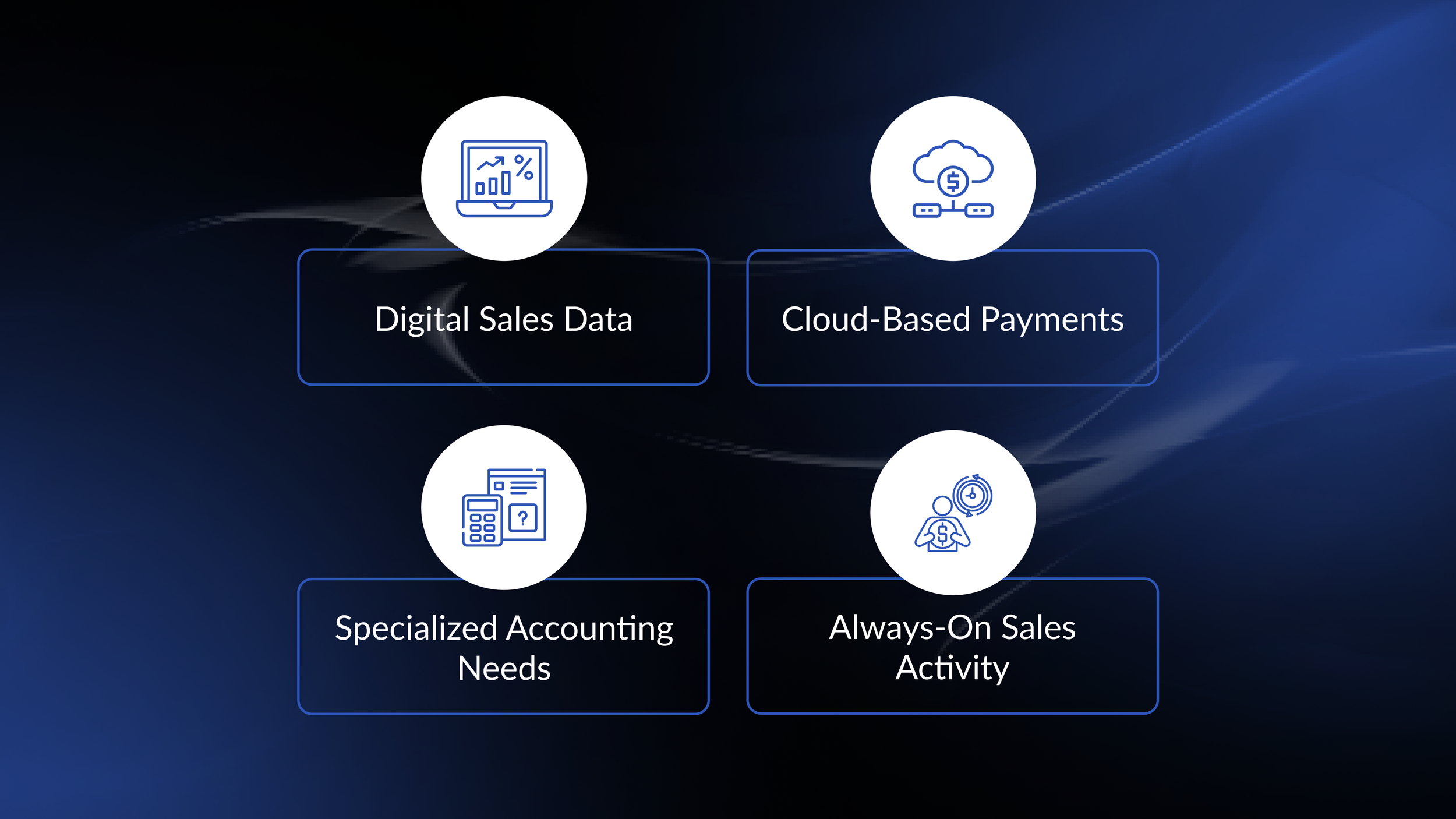
Several characteristics of the Ecommerce model make remote accounting a practical option:
Digital Sales Data: Shopify, Amazon, and other sales channels capture transaction data digitally, making it easy to access and reconcile remotely.
Cloud-Based Payments: Shopify Payments, Stripe, and PayPal provide digital transaction data that can flow into cloud-based accounting systems.
Specialized Accounting Needs: Multi-channel sales, inventory, and sales tax obligations require relevant expertise. The right accountant can support these needs regardless of location.
Always-On Sales Activity: Ecommerce orders come in across channels and time zones, and cloud systems can handle accounting work without relying on a local office.
What’s Included in Remote Accounting for Ecommerce Businesses?
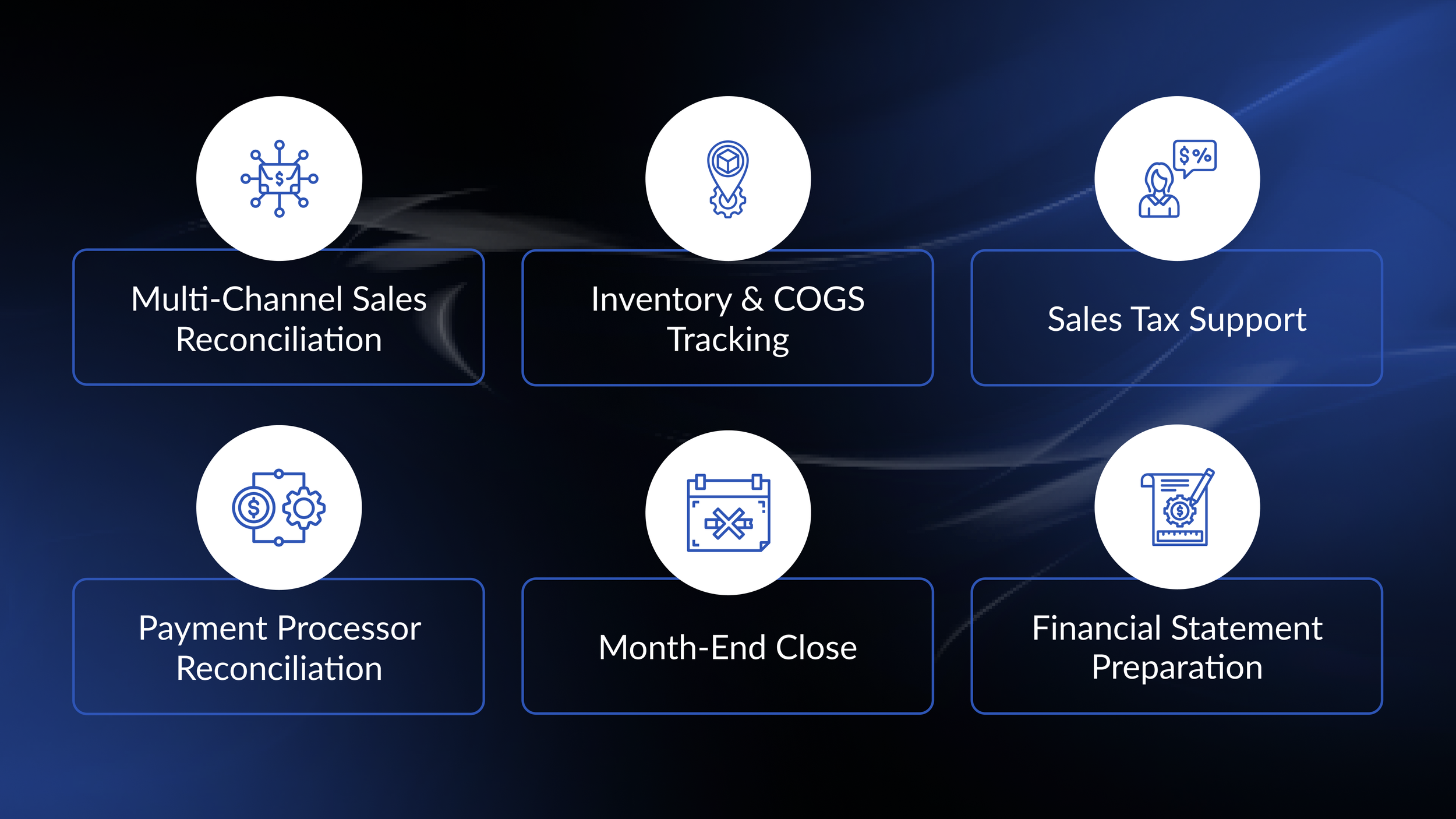
Depending on the engagement, remote accounting for an Ecommerce business can include:
Multi-Channel Sales Reconciliation: Matching sales and payout data from Shopify, Amazon, Walmart Marketplace, and other channels against your accounting records, so revenue is accurately reflected regardless of where a sale happened.
Inventory & COGS Tracking: Recording inventory costs accurately across suppliers and channels, so cost of goods sold reflects what products actually cost to acquire and deliver.
Sales Tax Support: Monitoring where your business has sales tax nexus as you grow into new states, and helping keep the underlying accounting records aligned with what’s owed.
Payment Processor Reconciliation: Matching Shopify Payments, Stripe, or PayPal payouts against actual sales, since payout timing rarely lines up neatly with the sales that generated them.
Month-End Close: Running a consistent remote close process, with results delivered through a shared dashboard.
Financial Statement Preparation: Producing income statements, balance sheets, and cash flow statements that reflect true channel-level performance, not just top-line revenue.
How Does Remote Accounting Work for an Ecommerce Business?
The mechanics are built to plug directly into the platforms most Ecommerce businesses already use:
Sales channel integrations connect Shopify, Amazon, and other marketplaces directly to your accounting software, so sales, fees, and refunds sync automatically instead of requiring manual entry from each channel separately.
Payment processor feeds pull in Shopify Payments, Stripe, or PayPal data directly, so payouts can be matched back to the sales that generated them.
Cloud accounting software (like QuickBooks Online or Xero) gives your remote team and internal staff real-time access to the same set of books.
Secure document portals handle sensitive financial and payment data instead of email attachments.
Scheduled video check-ins replace in-person meetings, typically monthly, with more frequent contact during peak season or a specific financial event.
Is Remote Accounting Secure for Ecommerce Companies?
Security is a fair concern for any Ecommerce business handling customer payment data and multiple channel integrations, and it deserves a direct answer.
Security comes down to the provider’s systems and access controls, not physical location. Look for a provider that offers:
Encrypted, cloud-based platforms rather than email attachments for sensitive financial or payment data
Defined, limited access permissions across every connected sales channel and payment processor
Two-factor authentication on any platform touching your financial or customer data
A clear, direct answer about data handling and retention, not a vague assurance
Given how many third-party integrations an Ecommerce business typically has- sales channels, payment processors, inventory tools- it’s worth confirming a provider takes access management as seriously as you’d expect from any vendor touching customer payment data.
5 Benefits of Remote Accounting for Growing Ecommerce Businesses
For Ecommerce companies, accounting needs grow more complex as channels, order volume, and inventory complexity increase. A remote accounting team can provide specialized support without requiring the business to build the entire function in-house.
1. Ecommerce-Specific Expertise
Work with accountants familiar with multi-channel reconciliation, inventory-based COGS, sales tax nexus, and channel-level margin analysis. This reduces the need to explain your business model’s accounting implications at every step, and the difference shows up in outcomes: according to TaxDome’s 2025 Niche Business Accounting Report, clients are willing to pay 25% more for a firm that specializes in their niche, and only 2% ever return to a generalist once they’ve worked with a specialist.
2. Accounting Support for Ecommerce Growth
As order volume and channel count increase, so does the reconciliation workload. A remote team can absorb that growth, including seasonal spikes around major sales events, without the delay of a local hiring search.
3. More Accurate Channel-Level Visibility
Knowing which channel, product line, or supplier is actually profitable requires accounting that separates performance by channel, not just a single blended revenue number. Dedicated remote support helps keep that breakdown accurate as complexity grows.
4. Sales Tax Support as You Expand
Crossing into new states brings new sales tax nexus questions. A remote provider experienced with Ecommerce can help you track where those obligations exist as your footprint grows.
5. Specialized Support Without a Full-Time Hire
A growing Ecommerce company may need expertise in multi-channel reconciliation, inventory accounting, and sales tax without needing a separate in-house employee for each skill. A remote team provides access to that capacity as needed.
How to Choose a Remote Accounting Provider for Ecommerce Business
Step 1: Check Their Ecommerce Accounting Experience
Ask whether they regularly handle multi-channel reconciliation, inventory-based COGS, and multi-state sales tax. Ecommerce accounting has real complexity that a generalist may not have encountered.
Step 2: Confirm Sales Channel and Payment Processor Expertise
Make sure they can work with your actual sales stack, Shopify, Amazon, Walmart Marketplace, Stripe, or whatever combination your business runs on.
Step 3: Review Their Security Controls
Ask how they handle encryption, authentication, and access permissions across every connected channel and processor.
Step 4: Define Your Reporting Needs
Confirm what you’ll receive and how often; channel-level P&Ls, inventory reports, and sales tax summaries may all matter depending on your business.
Step 5: Get the Scope in Writing
Clarify exactly what’s covered, including bookkeeping, reconciliations, inventory accounting, and sales tax support. A clear scope prevents gaps as your business grows.
How 1116 Partners Supports Growing Ecommerce Businesses
Here’s how we stack up against the criteria above, specifically:
Ecommerce expertise from day one: Multi-channel reconciliation, inventory-based COGS, and sales tax complexity are a core part of our practice, not something we’re learning in your books.
Direct integration with your sales stack: We work with Shopify, Amazon, and major payment processors, so channel data flows accurately into your books without manual reconciliation.
Defined security and access controls: We use encrypted, cloud-based systems with established access permissions across every connected platform.
Reporting built around your actual business: Channel-level visibility and reporting cadence built around your actual sales patterns, not a generic template.
A scope that grows with you: 1116 Partners brings Controllers and Senior Accountants into the relationship as your needs grow, starting with Outsourced Accounting Services and Ecommerce Accounting Services, and extending into Month-End Close Services & Fractional Controller Services as your business matures.
Get Remote Accounting Built for Your Ecommerce Business With 1116 Partners

Your sales already happen across channels. Your payments already run through the cloud. Your accounting should keep pace with how your business actually sells.
1116 Partners provides remote accounting support as part of our Outsourced Accounting Services and Ecommerce Accounting Services, built for growing Ecommerce companies that need a team fluent in multi-channel sales, not one learning it on your books.
FAQs
-
It depends on the provider; this is worth confirming directly before signing on. A generalist bookkeeper may not have direct experience reconciling sales across Shopify, Amazon, and other channels, while an Ecommerce-focused provider will already be fluent in it.
-
Security depends on the provider’s systems, not physical location. Look for encrypted platforms, defined access controls, and two-factor authentication across every connected sales channel and payment processor.
-
Yes. Many Ecommerce businesses use remote accounting to supplement internal staff, handling bookkeeping, reconciliations, or reporting while internal team members focus on other priorities.
-
An Ecommerce-experienced provider monitors where your business has established sales tax nexus as you grow and helps keep your accounting records aligned with what’s actually owed, though final filing responsibilities should be confirmed as part of the engagement scope.
-
Most combine cloud accounting platforms like QuickBooks Online or Xero with integrations for sales channels like Shopify and Amazon, plus payment processors like Stripe or PayPal.
