

What Are Financial Accounting Advisory Services? Everything You Need To Know
Your company just signed a term sheet, and the investor’s due diligence team is asking technical accounting questions your bookkeeper has never had to answer: how should this convertible note be classified, what’s the right treatment for this earn-out, does your revenue recognition actually hold up under scrutiny?
Your books are accurate. That was never the problem. The problem is this isn’t routine work, and it’s happening on a deadline you didn’t choose.
So what are financial accounting advisory services, and how do you know if you actually need them? Here’s the short answer: Financial accounting advisory services, sometimes referred to as financial advisory accounting, provide senior-level, project-based accounting expertise for complex or non-routine matters, M&A accounting, technical accounting research, new standard implementation, and transaction readiness, rather than the ongoing, recurring work of monthly bookkeeping or financial statement preparation.
It’s advisory by nature: brought in for a specific event, not a standing monthly service.
This blog breaks down what financial accounting advisory services actually include, how they differ from ongoing accounting support, and when a growing business genuinely needs them.
Key Takeaways
- Financial accounting advisory services are project-based and episodic, not ongoing or recurring like monthly bookkeeping or financial reporting.
- They’re distinct from both financial accounting services (routine statement preparation) and client accounting services (bundled, ongoing support).
- Common triggers include M&A activity, adoption of new accounting standards, restatements, IPO readiness, and leadership transitions.
- This work is inherently judgment-heavy; it requires senior accounting expertise, not just accurate bookkeeping.
- Financial accounting advisory connects directly to CFO-level strategic decisions, which is why it’s typically delivered alongside strategic advisory support.
What Are Financial Accounting Advisory Services?
Financial accounting advisory services provide senior accounting expertise for complex, technical, or non-routine matters, the kind of accounting questions that don’t come up in a normal monthly close but carry real consequences if handled incorrectly.
This is different from the accounting work most growing businesses are used to.
Monthly bookkeeping and financial statement preparation are recurring by design, with established processes repeated each period. Financial accounting advisory is more situation-specific. You typically need it when a transaction, a change in accounting guidance, an accounting error, or another complex issue requires specialized technical judgment.
1116 Perspective: Matching Expertise to the Need
The gap we see most often isn’t a lack of accounting capability. It’s a lack of the specific expertise a business needs when a more complex situation comes up. A team that handles the monthly close well may not have the specialized experience needed for purchase price allocation during an acquisition, and that’s perfectly normal. Different accounting needs call for different areas of expertise, brought in at the right time.
What Do Financial Accounting Advisory Services Include?

Depending on the situation, financial accounting advisory services can include:
Technical Accounting Research: Working through complex or ambiguous GAAP questions and documenting the position taken, with the analysis to support it.
M&A Accounting Support: Purchase price allocation, opening balance sheet preparation, and accounting for deal-related transactions.
New Accounting Standard Implementation: Adopting standards like ASC 606 (revenue recognition) or ASC 842 (leases) correctly, including the transition itself, not just ongoing compliance.
Financial Statement Restatements: Correcting errors in previously issued financial statements and managing the process required to do so properly.
IPO & Transaction Readiness: Preparing financial statements and supporting documentation to the standard required for a public offering or major transaction.
Interim CFO or Controller Support: Providing senior accounting leadership during a transition so critical reporting doesn’t stall while a permanent hire is made.
Due Diligence Support: Preparing for or responding to buy-side or sell-side due diligence requests during a transaction.
Finance Function Process Improvement: Identifying and fixing structural gaps in how the finance function operates, not just solving the immediate technical question, but improving the process that let the gap happen.
Why Businesses Are Turning to Financial Accounting Advisory Services
According to ResearchAndMarkets.com, the global financial accounting advisory services market was valued at roughly $101.6 billion in 2024 and is expected to keep growing through the decade. This points to growing demand for specialized accounting expertise as businesses face more complex transactions and reporting requirements.
Furthermore, as businesses grow, routine accounting may not cover every situation. An acquisition can raise unfamiliar accounting questions. A new standard may require changes to existing policies. Investors, lenders, or auditors may also need more detailed analysis than a standard monthly close provides.
Financial accounting advisory services give businesses access to specialized expertise when these situations arise, without requiring them to maintain every technical skill in-house.
A few factors are driving this need:
M&A and transaction accounting: Acquisitions can require purchase price allocation, opening balance sheet adjustments, fair value considerations, and accounting for deal-related transactions that fall outside routine monthly accounting.
New accounting requirements: Adopting guidance such as ASC 606 for revenue recognition or ASC 842 for leases can require businesses to determine how the new rules apply to their specific contracts, transactions, and existing accounting policies.
Investor and audit scrutiny: Fundraising, due diligence, audits, and other major reviews can require detailed accounting positions, supporting schedules, and documentation that goes beyond standard financial statement preparation.
Limited technical expertise internally: An internal accounting team may handle the monthly close effectively but have limited experience with areas such as purchase accounting, complex revenue arrangements, technical GAAP research, or restatements.
Accounting decisions with lasting impact: Some accounting conclusions affect financial statements well beyond the immediate issue. Businesses may need experienced judgment to assess the facts, determine the appropriate treatment, and document the position taken.
The common thread is timing. Businesses may not need this level of expertise every month, but when a complex accounting issue arises, having access to the right experience can help them address it without disrupting their ongoing accounting work.
Who Needs Financial Accounting Advisory Services?
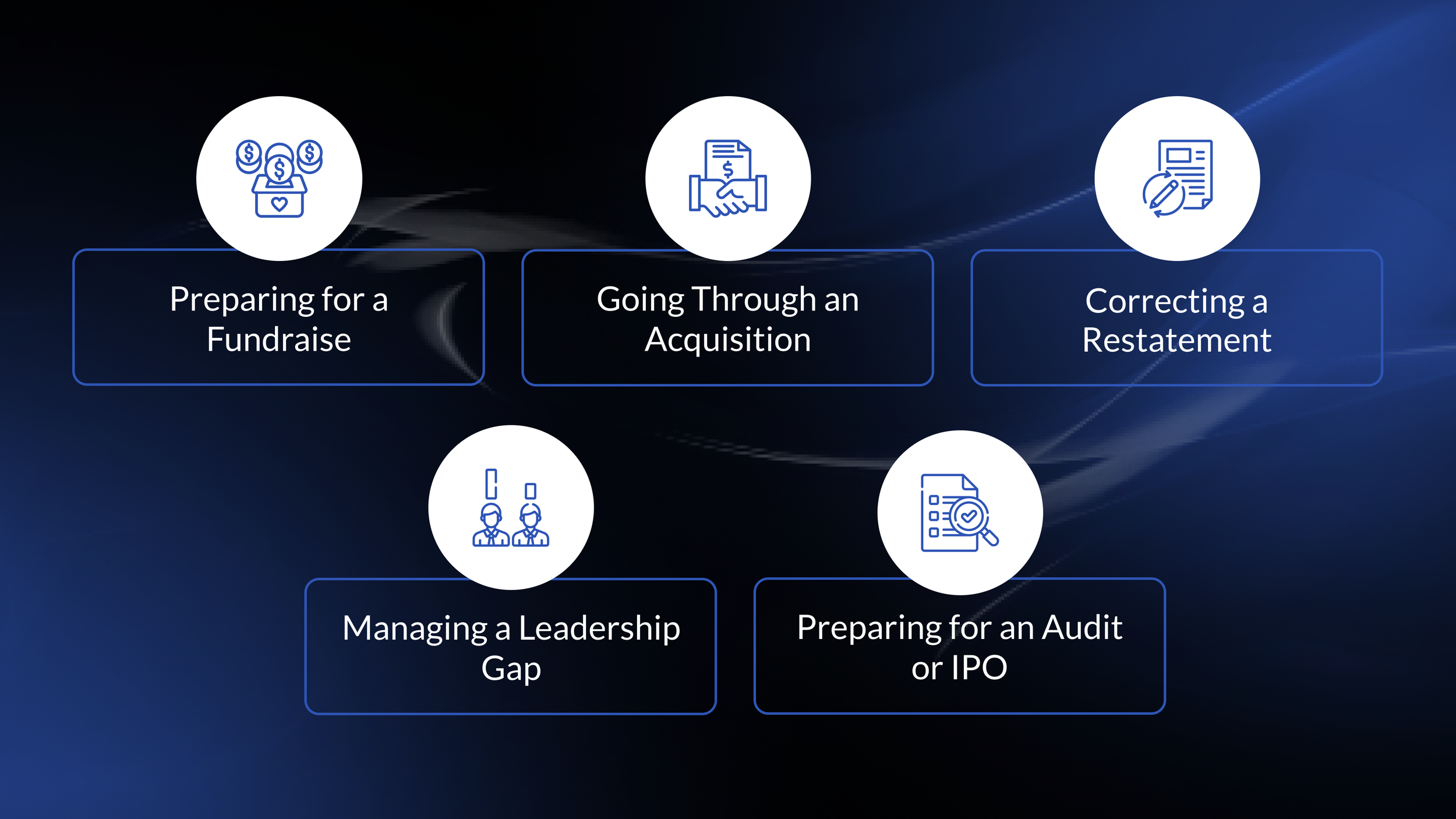
Businesses typically need financial accounting advisory services when a situation goes beyond routine accounting processes. Triggers can include a major transaction, a change in accounting guidance, an accounting error, or a gap in senior finance leadership.
Here are some of the situations where specialized advisory support can make a difference:
1. Preparing for a Fundraise
A SaaS company preparing for investor due diligence may need to adopt new revenue recognition guidance or revisit how certain transactions are accounted for.
Advisory support: Review the accounting treatment, address potential issues, and help ensure the financials are accurate and well supported before investors take a closer look.
2. Going Through an Acquisition
An e-commerce or high-growth business entering an acquisition or roll-up may suddenly face requirements for purchase accounting, purchase price allocation, and an opening balance sheet.
Advisory support: Bring specialized transaction accounting expertise to work through areas that may fall outside the internal team’s usual responsibilities.
3. Correcting an Accounting Error
An unexpected accounting error can lead to a restatement, requiring you to determine what went wrong, how to correct it, and how to document the correction.
Advisory support: Establish the appropriate accounting treatment and build the supporting documentation needed for the correction.
4. Managing a Leadership Gap
When a CFO or Controller leaves unexpectedly, important accounting and reporting work must continue while the business searches for a replacement.
Advisory support: Provide experienced accounting oversight during the transition so reporting and critical financial processes continue.
5. Preparing for an Audit or IPO
A first audit, IPO, or other significant external review can bring a level of scrutiny that a company’s existing accounting processes have not previously faced.
Advisory support: Identify accounting and reporting issues early and strengthen the financial statements and supporting records before the review begins.
1116 Perspective: Planning for Specialized Expertise
The cost of not having this expertise available isn’t visible until the moment you need it, and by then, it’s usually urgent. Businesses that plan for these events in advance have a real advantage over those scrambling to find senior accounting judgment during a live transaction.
When Do You Need Advisory Support vs. Ongoing Accounting Help?
If your accounting needs are recurring, monthly close, regular financial statements, day-to-day bookkeeping, that’s ongoing accounting or CAS territory. If you’re facing a specific, non-routine event with real technical complexity- a transaction, a standard change, a restatement, a leadership gap- that’s when financial accounting advisory becomes the right fit.
Many businesses need both at different points: ongoing support to keep the finance function running, and advisory support brought in specifically when a complex event demands it.
How Financial Accounting Advisory Services Differ From Financial Accounting Services & CAS
Financial accounting advisory sits alongside two other services we’ve covered, financial accounting services and client accounting services (CAS), but each serves a different purpose:
| Feature | Financial Accounting Services | Client Accounting Services (CAS) | Financial Accounting Advisory Services |
|---|---|---|---|
| Nature | Ongoing, recurring | Ongoing, bundled | Project-based, episodic |
| Typical trigger | Standard reporting cadence | Ongoing need for a coordinated finance function | A specific event, M&A, IPO, restatement, new standard |
| Core focus | Routine GAAP statement preparation | Full-spectrum accounting plus advisory | Complex, technical, judgment-heavy accounting matters |
| Best fit | Businesses needing standardized external reporting | Businesses needing a fully outsourced finance function | Businesses facing a specific, high-stakes accounting event |
These aren’t competing services; many businesses use financial accounting or CAS support for their ongoing needs and bring in financial accounting advisory specifically when an event outside that normal cadence occurs.
Get Accounting Judgment When It Matters Most With 1116 Partners

Accurate books handle the routine. Financial accounting advisory handles the moments that aren’t transactions, standard changes, or restatements that need to be done right the first time.
Now that you know what financial accounting advisory services are and when they actually matter, the next step is knowing who to call when that moment arrives.
1116 Partners provides financial accounting advisory as part of our Strategic CFO Advisory Services, working alongside our Financial Reporting Services and Fractional Controller Services, including support built for growing Ecommerce and SaaS companies navigating fundraising, acquisitions, and complex accounting events.
FAQs
-
They’re senior-level, project-based accounting support for complex or non-routine matters, technical accounting research, M&A accounting, new standard implementation, and transaction readiness, brought in for a specific event rather than delivered on an ongoing basis.
-
Yes. It’s typically designed to work alongside your existing team, not replace them, bringing in specific technical expertise for the situation at hand while your team continues handling day-to-day accounting. This is exactly how 1116 Partners approaches it: we step in for the specific event, coordinate directly with your bookkeeper or controller, and step back once the work is done, rather than inserting ourselves into your ongoing accounting relationship.
-
Yes, you may need financial accounting advisory even if you have an accountant. Especially for specific situations. A capable accountant or bookkeeper handles routine work well, but complex, non-routine matters, such as M&A accounting or other technical requirements, typically call for specialized expertise brought in for that specific event.
-
Yes. Chartered Accountants (CAs) frequently provide financial and accounting advisory services, including technical accounting, transaction, and reporting support covered in this guide. That said, providing regulated financial advice, like investment or wealth management guidance, typically requires separate licensing or registration, depending on the jurisdiction, and is distinct from a CA’s core accounting qualification.
-
It varies by scope; some engagements resolve in a few weeks (a technical position memo), while others, such as IPO readiness or a major standard implementation, can run for several months.
