

What Is Financial Accounting Service? A Complete Guide
Key Takeaways
- Financial accounting services prepare GAAP-compliant financial statements for external stakeholders, investors, lenders, auditors, and regulators.
- It’s distinct from bookkeeping, which records transactions, and from management accounting, which serves internal decision-making.
- Core deliverables include the income statement, balance sheet, cash flow statement, and the supporting notes and disclosures that accompany them.
- Growing companies typically need this level of support once external stakeholders start requiring formal, standardized reports.
- Financial accounting connects directly to month-end close, controller oversight, and financial reporting; it doesn’t operate as a standalone task.
Your bookkeeper closes the books every month. The numbers are accurate, reconciled, and up to date. Then an investor asks for GAAP-compliant financial statements, or your bank requests formal financials for a credit renewal, and you realize the reports you have aren't prepared for that level of review.
That's where dedicated support can help. It takes the underlying accounting records and prepares the standardized financial statements external stakeholders rely on, including the income statement, balance sheet, and cash flow statement.
This blog explains what a financial accounting service includes, how financial accounting differs from bookkeeping and management accounting, and when your business may need this level of support.
What Is Financial Accounting?
Financial accounting is the branch of accounting focused on producing standardized financial statements for people outside the business, investors, lenders, auditors, and regulators, who need a reliable, consistent way to evaluate financial performance and position.
In the U.S., financial accounting follows GAAP (Generally Accepted Accounting Principles), the standards established by the FASB (Financial Accounting Standards Board). That standardization matters because investors comparing two companies need their financial statements to follow consistent rules for the comparison to be meaningful.
Bookkeeping provides the underlying records. It involves recording transactions, reconciling accounts, and keeping financial data up to date. Financial accounting builds on those records to prepare the formal, standardized financial statements that external stakeholders rely on.
Management accounting serves a different purpose. It is developed for internal decision-making and can include budgets, forecasts, cost analyses, and other reports that help leadership plan and manage the business. These internal reports don’t have to follow GAAP because they aren’t prepared for external users.
Client accounting services (CAS) take a broader approach. A CAS engagement can combine financial accounting with bookkeeping, AP, month-end close, controller oversight, and CFO advisory.
Financial accounting is one component of that broader model, focused on maintaining GAAP-based financial information and preparing standardized financial statements.
1116 Perspective | Accurate Books Aren’t Always Enough
A business can have accurate books and still struggle when an investor, lender, or auditor asks for formal financial statements. Keeping the records current is one part of the work. Making sure they’re ready for external review is another.
What Does a Financial Accounting Service Include?
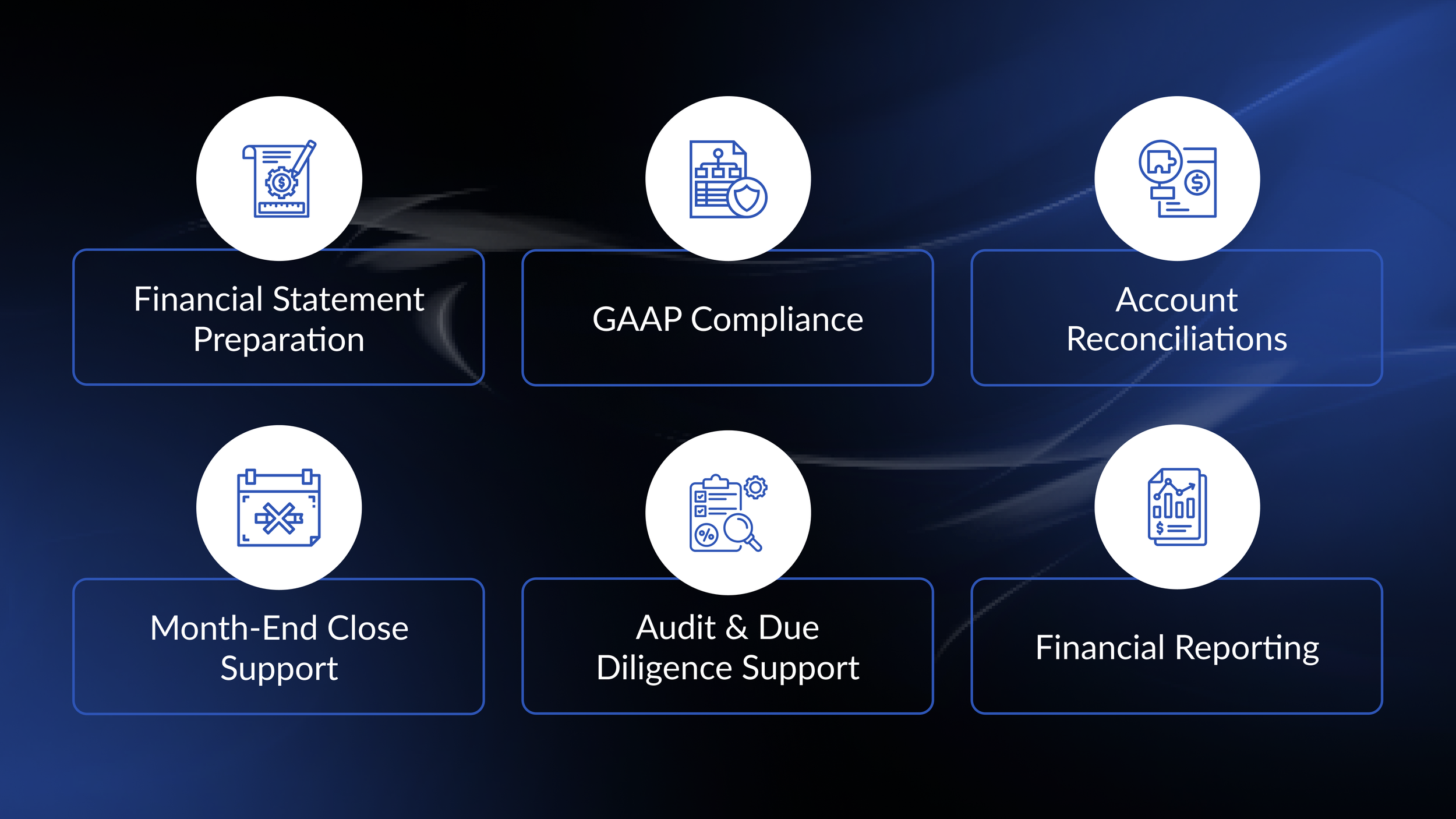
Depending on the scope of the engagement, the engagement can include:
1. Financial Statement Preparation
A financial accounting service can prepare the core financial statements your business relies on, including the income statement, balance sheet, and cash flow statement. These statements organize your financial information into a format that helps leadership and external stakeholders understand the company’s financial position and performance.
2. GAAP Compliance
Financial accounting services can help apply GAAP to your financial reporting. This includes maintaining consistent accounting treatment and ensuring financial statements are prepared in accordance with applicable U.S. accounting standards.
3. Account Reconciliations
Reconciliations compare account balances against supporting records to identify and resolve discrepancies. This can include bank accounts, credit cards, accounts receivable, accounts payable, and other balance sheet accounts. Regular reconciliations help keep financial statements based on accurate, up-to-date information.
4. Month-End Close Support
Month-end close brings together the accounting work needed to finalize a reporting period. Financial accounting support may include accruals, adjusting entries, account reconciliations, and the review of balances before financial statements are prepared. A consistent close process also helps your team get reliable financial information on a regular schedule.
5. Audit & Due Diligence Support
When an auditor, lender, or investor requests financial information, your accounting records need to be organized and supported. This support can help prepare accounting schedules, supporting documentation, reconciliations, and financial information needed during an audit, financing process, or due diligence review.
6. Financial Reporting
Some engagements also include recurring financial reports that give leadership and external stakeholders a clearer view of the business. Depending on your needs, reporting may cover revenue, expenses, profitability, cash flow, assets, liabilities, and other key financial information.
Some providers bundle financial accounting with bookkeeping and reporting as one continuous service; others provide it specifically as the layer that sits on top of clean books. The three areas are closely related, but they serve different purposes.
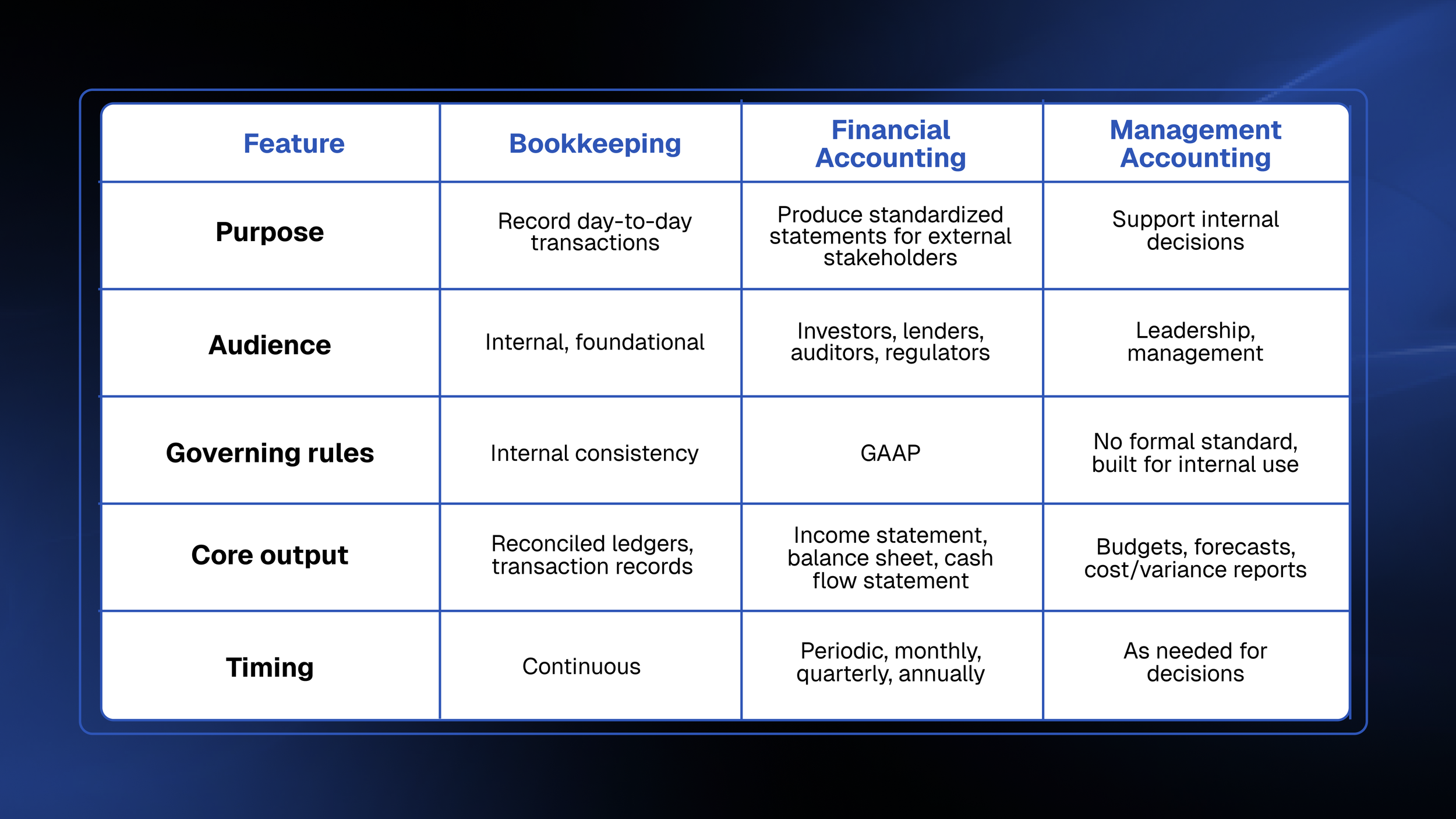
Bookkeeping records the transactions, financial accounting prepares that information for formal financial reporting, and management accounting uses financial data to support internal decisions. Here’s how they compare.
Financial Accounting vs. Bookkeeping vs. Management Accounting
These three areas often work with the same underlying financial information, but they serve different purposes. Bookkeeping records transactions, financial accounting prepares information for formal financial reporting, and management accounting uses financial data to support internal decisions.
When Does Your Business Need Financial Accounting Services?
You may not need dedicated financial accounting support from day one. The need often becomes clearer when your financial reporting gets more demanding, your internal team has less capacity, or outside stakeholders start asking for more detailed financial information.
You may benefit from this level of support when:
Investors request formal financial statements: During a fundraise, investors may want current, GAAP-compliant financial statements and supporting information as part of their review, a common milestone for growing SaaS and e-commerce companies as they scale beyond early-stage bookkeeping.
Lenders require updated financials: Banks and other lenders may request financial statements when you apply for financing, renew a credit facility, or provide ongoing financial information under a lending agreement.
Your business is preparing for an audit: An audit can require organized financial records, reconciliations, supporting schedules, and documentation for reported balances. Having these processes in place can make the preparation easier for your internal team.
You’re entering due diligence: A potential acquisition, investment, or other transaction can bring detailed requests for financial statements and supporting records. Reliable financial accounting can help your team respond without scrambling to reconstruct past information.
Bookkeeping no longer meets your reporting needs: Your books may be accurate, but your business still needs formal financial statements, GAAP-based reporting, or a more detailed review of account balances.
Month-end close is becoming harder to manage: As transactions, accounts, and reporting requirements grow, your internal team may need additional support with reconciliations, accruals, adjusting entries, and financial statement preparation.
Growing Ecommerce and SaaS revenue outpaces what your books were built for: As transaction volume, multi-channel sales, or recurring subscription revenue scales, financial statements need to keep pace. This is often exactly when e-commerce and SaaS businesses first need dedicated financial accounting rather than standard bookkeeping alone.
That need isn't determined by revenue only. Your reporting requirements, ownership structure, financing activity, transaction plans, and accounting complexity can all affect when additional support makes sense.
1116 Perspective | Build Before You Need It
Financial accounting often becomes a priority when an investor, lender, or auditor is already asking for the numbers. Putting the right accounting processes in place earlier gives your team more time to prepare and fewer surprises when those requests come in.
How Financial Accounting Supports Reporting & Planning
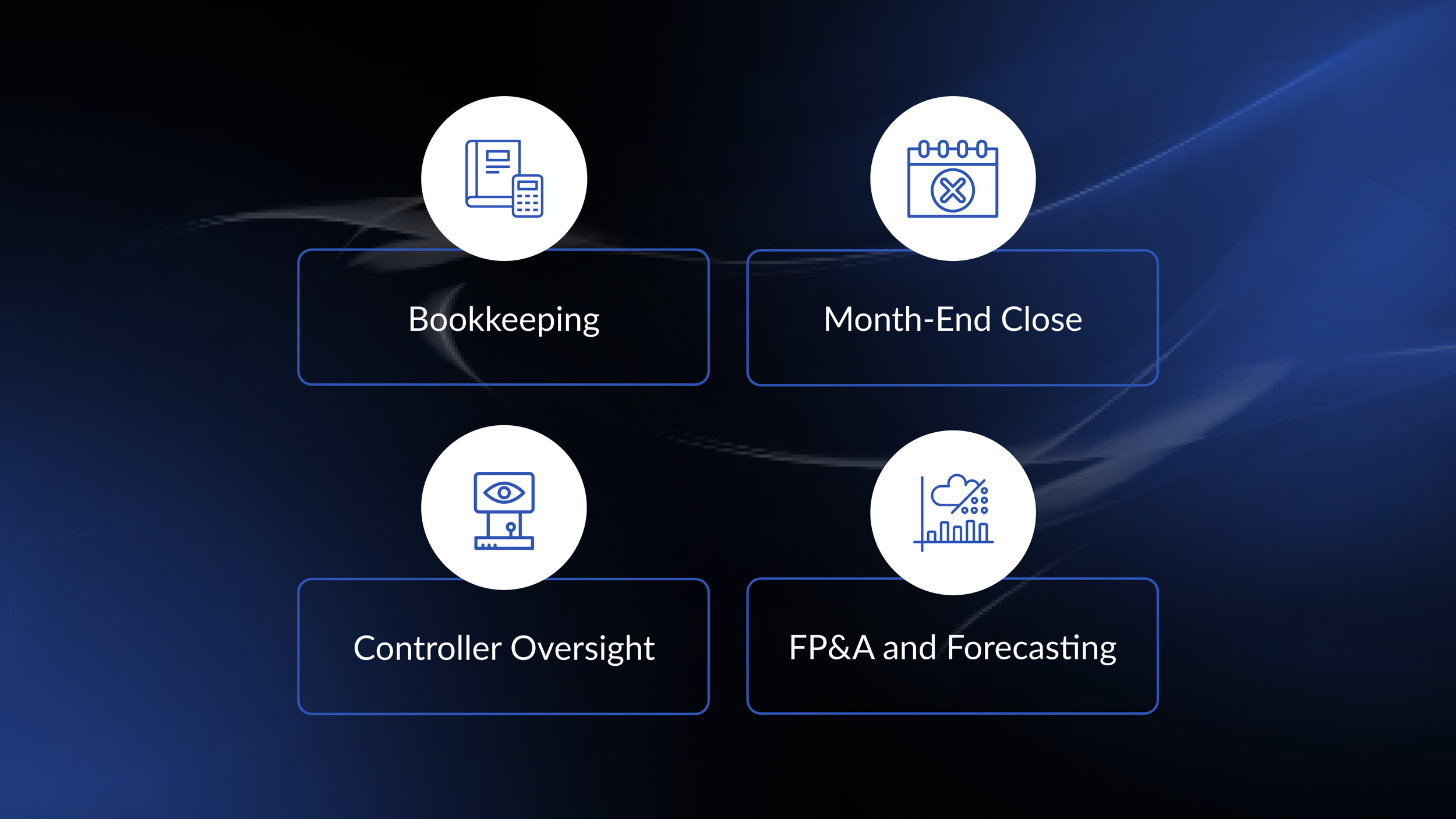
Financial accounting supports more than just preparing financial statements. It also gives other parts of your finance team reliable information. When the records are accurate and up to date, each part of the process can build on the work that comes before it.
Bookkeeping: Accurate records are the starting point. Financial accounting relies on complete and up-to-date transaction records. When the underlying books are accurate, financial statements have a stronger foundation.
Month-End Close: Reliable numbers depend on a consistent close. Reconciliations, accruals, adjusting entries, and account reviews help ensure your financial information is complete before you finalize the reporting period.
Controller Oversight: Ongoing review keeps accounting on track. Controller support can help review account activity, maintain consistent accounting practices, address issues, and support GAAP compliance throughout the year.
FP&A and Forecasting: Historical data supports future planning. Financial statements give FP&A teams a reliable view of past performance, which they can use to develop forecasts, assess trends, and plan for future financial needs.
Financial accounting can also be part of a broader client accounting services engagement, working alongside bookkeeping, AP, controller support, and CFO advisory when your business needs a wider range of accounting and finance support.
What to Look for in a Financial Accounting Service Provider
Choosing the right provider involves more than finding someone who can prepare financial statements. You also want a provider that can work within your existing accounting processes and support the level of reporting your business requires.
Look for:
GAAP expertise: The provider should understand applicable U.S. GAAP requirements and how they affect your financial reporting.
Accounting system experience: Familiarity with your accounting software can make it easier to maintain records and fit financial accounting into your existing workflow.
A clear month-end process: Ask how the provider handles reconciliations, adjusting entries, reviews, and financial statement preparation.
Strong reconciliation practices: Regular, well-documented reconciliations help identify discrepancies before they affect your financial statements.
Audit and reporting support: Consider whether the provider can prepare financial information and supporting documentation when lenders, investors, or auditors request it.
Clear communication and ownership: You should know who is responsible for each part of the process and who on your team to contact when questions or issues arise.
1116 Partners brings these pieces together through financial accounting support devised to align with your existing finance processes.
Build More Reliable Financial Reporting With 1116 Partners
Accurate books give you the numbers you need, but sometimes those numbers need to withstand a closer look. Investors may want financials during due diligence, lenders may ask for updated statements, or an auditor may need supporting records. Having reliable, GAAP-compliant financial statements ready can make those situations much easier to manage.
1116 Partners provides financial accounting support, including Financial Reporting Services, Outsourced Bookkeeping Services, Month-End Close Services, and Fractional Controller Services, as well as Ecommerce- and SaaS-specific accounting support for growing companies. This gives growing businesses a consistent accounting process that keeps financial records current and reporting-ready.
FAQs
-
No. Bookkeeping records the underlying transactions; financial accounting uses that data to prepare formal, GAAP-compliant financial statements for external stakeholders like investors and lenders.
-
Not always. A small business with no outside investors, lenders, or audit requirements may only need accurate bookkeeping. Financial accounting becomes necessary once external stakeholders require standardized, GAAP-compliant statements.
-
Financial accounting produces the core statements: the income statement, balance sheet, and cash flow statement under GAAP. Financial reporting typically builds on those statements with broader context: management commentary, KPIs, and analysis for leadership and investors.
-
Financial statements may be prepared monthly, quarterly, or annually, depending on the business and the needs of its stakeholders. Many growing businesses prepare them monthly for internal review and produce quarterly or annual statements for external users.
-
Yes. Financial accounting builds on bookkeeping rather than replacing it; many businesses keep their existing bookkeeping in place and add financial accounting as the layer that turns that data into formal, external-facing statements.
