

7 Benefits of Outsourcing Accounts Payable for Growing Companies
Key Takeaways
- Outsourced accounts payable services typically cost significantly less per invoice than manual, in-house processing, especially as volume grows.
- Accounts payable outsourcing services let a company scale invoice volume without scaling headcount at the same rate.
- Stronger approval controls and segregation of duties are direct benefits of outsourcing AP, not just a processing convenience.
- The cost of staying in-house too long isn’t just labor; it’s missed early-payment discounts, late fees, and errors that compound as volume grows.
- The right time to outsource accounts payable services is usually earlier than most growing companies think.
Running a growing company means making dozens of decisions every day, from which AI tools to invest in and how customers experience your website to where your team should focus next. There’s only so much time and attention to go around.
As the business grows, the functions that once ran smoothly in the background can start to feel the strain, too. Accounts payable (AP) is often one of them.
Six months ago, your internal team may have handled AP without much trouble. Invoices came in, were coded, approved, and paid alongside their other responsibilities. Now, invoice volume has tripled, vendors are following up on payment status, and the same person who once spent a few hours a week on AP is dealing with it every day.
As your business grows, your AP process can struggle to keep pace with increasing volume. When routine AP takes time away from higher-value finance work, accounts payable outsourcing services can add capacity without increasing internal workload.
In this blog, we’ll look at seven benefits of outsourcing accounts payable, including lower processing costs, faster invoice cycles, stronger controls, better AP visibility, and more capacity for your finance team.
Let’s start by understanding the signs that your current AP setup may already be stretched too thin.
5 Signs Your Company Has Outgrown Its In-House AP
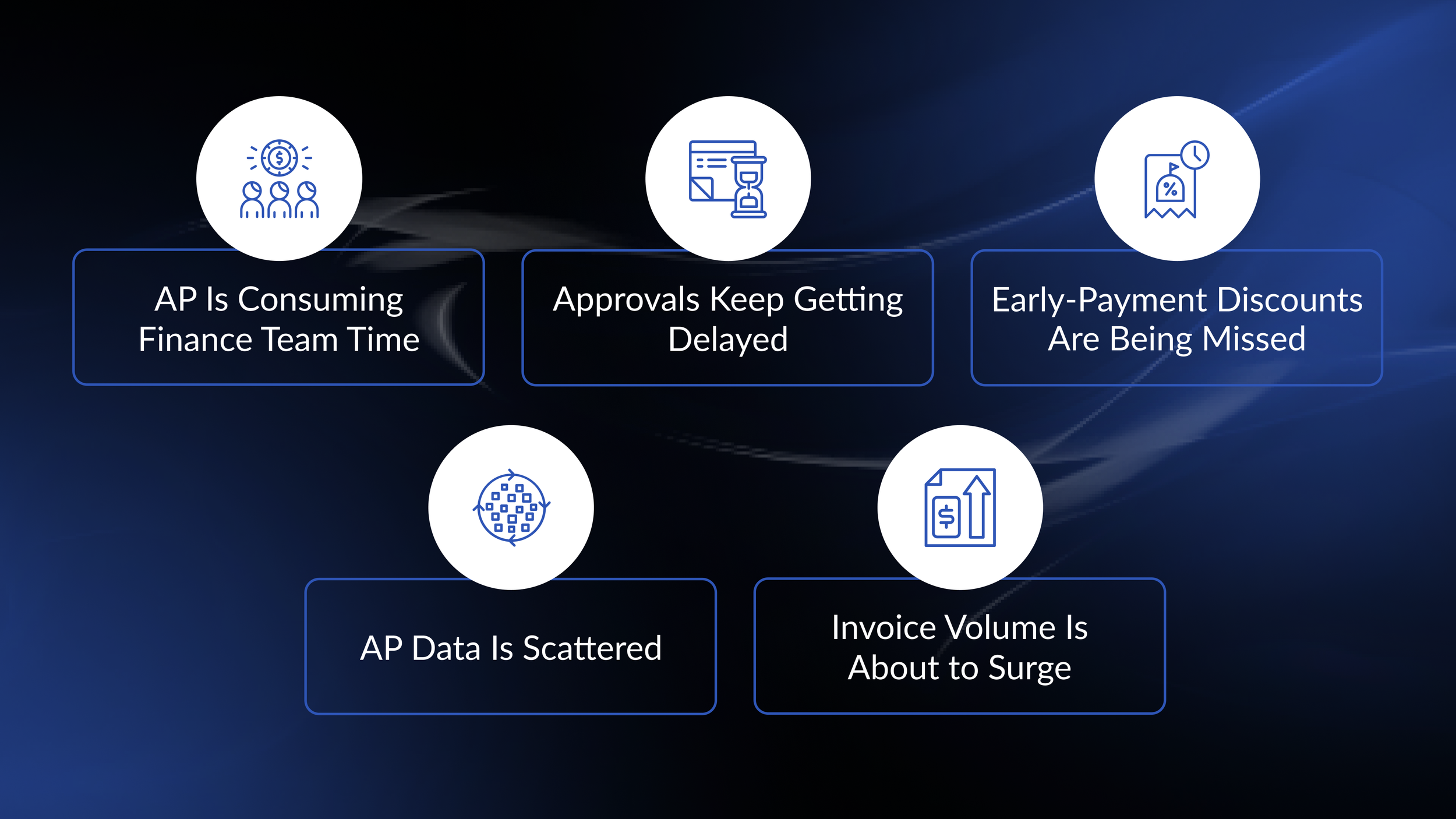
Most companies don’t decide to outsource AP because of a single event; it’s usually a pattern that builds over months, one invoice at a time. A few signs it’s time to look at accounts payable outsourcing services:
1. AP Is Consuming Finance Team Time
Your accounts payable staff is spending most of the week processing invoices instead of focusing on higher-value finance work. When AP grows from a few hours a week to a daily responsibility, accounts payable outsourcing services can add capacity without increasing the internal workload.
2. Approvals Keep Getting Delayed
Invoices routinely stall because the right approver is traveling, out sick, or simply backed up. When the approval chain depends on a few people, even short delays can hold up the entire payment process.
3. Early-Payment Discounts Are Being Missed
Invoices are sitting too long before being processed, causing your business to miss out on available early-payment discounts. A standard 2/10 net 30 term can represent roughly a 37.2% annualized return when you capture the discount.
Formula:
[Discount % ÷ (100% − Discount %)] × [365 ÷ (Full Term − Discount Term)]
4. AP Data Is Scattered
Nobody can quickly answer, “What do we currently owe?” without pulling information from multiple spreadsheets or systems. When AP data requires manual work to access, it becomes harder for finance leaders to manage cash and upcoming obligations.
5. Invoice Volume Is About to Surge
You’re adding a new entity, location, or vendor base that could significantly increase invoice volume. Outsourcing accounts payable services can provide additional processing capacity before rising transaction volume becomes a bottleneck.
A quick check: If two or more of the above sound familiar, the function has outgrown its current setup. Three or more, and it’s less a question of whether to consider outsourcing accounts payable services and more a question of how soon.
7 Benefits of Outsourcing Accounts Payable for Growing Companies

Accounts payable outsourcing services deliver a range of benefits, but for a growing company, some matter more than others. Here’s what actually changes once AP moves off your internal team’s plate:
1. Reduce AP Processing Costs
Manual, in-house invoice processing can be expensive in ways that don’t appear on a single line item. APQC benchmarking research found that top-performing AP organizations have AP costs roughly one-fifth of those of bottom-quartile organizations, measured by cost per invoice processed.
They also found that top-performing AP functions tend to use standardized, largely automated processes, helping reduce the resources required to process invoices and improve overall efficiency.
As invoice volume grows, even relatively small differences in processing efficiency can have a meaningful impact on finance costs and internal capacity. That is one reason accounts payable outsourcing services can become more attractive as a company scales.
2. Optimize Invoice Processing
Cost isn’t the only area where AP performance can vary. APQC’s benchmarking research found that top-performing organizations process invoices from receipt to payment in about half the time of bottom-performing organizations. Even moving toward median performance can help bottom performers reduce cycle time by roughly a week.
For a growing company, shorter cycle times can reduce payment delays, improve visibility into outstanding obligations, and keep invoices from sitting in approval queues.
The benefit is not simply faster processing. It is a more consistent AP process that puts less pressure on your finance team as invoice volume grows.
3. Strengthen AP Controls
Outsourcing accounts payable services can bring more structure to invoice approvals, payment workflows, and segregation of responsibilities. Instead of one person handling most of the AP process, you can divide responsibilities so processing, approval, and reconciliation aren’t all handled by the same person.
That becomes increasingly important as your business grows. A lean AP team may manage a simple process at first, but maintaining proper checks becomes harder as invoice volume increases. Clear approval rules and separated responsibilities help reduce the risk of unauthorized and duplicate payments, as well as other avoidable errors.
For example, one person can process the invoice, another can approve it, and a separate person can reconcile the payment. This creates checks at each stage without adding unnecessary complexity to your finance function.
4. Scale Business Without Rising Headcount
This is the benefit growing companies feel most directly. Invoice volume that doubles doesn’t require doubling your internal AP staff when you’ve outsourced the function; an outsourced provider absorbs volume increases as part of the service, rather than triggering a new hire every time the business grows.
It’s even more significant during specific growth events: opening a new location, integrating an acquisition, or launching in a new market can spike invoice volume overnight. An in-house team has to hire ahead of that spike or fall behind during it. Accounts payable outsourcing services can absorb that increase without requiring a proportional increase in internal AP headcount.
5. Reduce Errors & Rework
Manual data entry is where most AP errors originate: a miskeyed amount, a duplicate payment, a mismatched PO. Outsourcing accounts payable services to a team with established validation processes reduces how often these errors happen in the first place, and each one avoided is time your internal team doesn’t spend tracing down a discrepancy after the fact.
The real cost of an AP error is rarely the error itself; it’s the investigation. A miskeyed invoice amount discovered during month-end close can consume hours of someone’s time reconstructing what actually happened, time that a cleaner process would have avoided entirely.
6. Improved AP Visibility
A growing company juggling AP across spreadsheets, email threads, and someone’s memory loses visibility fast. Outsourced accounts payable services typically include structured reporting, AP aging, outstanding balances, and payment status, giving leadership a clear, current answer to “what do we owe and when is it due,” rather than a scramble to reconstruct it before a board meeting or a cash flow decision.
This visibility compounds in value as a company grows. A $500K/month business can often get away with informal AP tracking. A $5M/month business generally can’t; the volume alone makes “check the spreadsheet” an unreliable answer.
7. Grow Your Accounting Expertise
An outsourced AP provider should do more than process invoices. A good provider understands how AP connects to the general ledger, account reconciliations, and month-end close. Incomplete or outdated AP records can slow the close and create extra work for the accounting team.
That’s why AP shouldn’t operate as a separate function. Clean, up-to-date AP records feed directly into accurate financial reporting and a smoother month-end close.
An accounts payable outsourcing service that works alongside your broader bookkeeping function keeps invoice processing connected to the rest of your books, so your internal team doesn’t have to reconcile disconnected AP data later.
1116 Perspective | Controllers Shouldn’t Be Chasing Invoices
The benefit growing companies underestimate isn’t cost; it’s attention. When AP is handled well, your Controller spends less time chasing approvals and more time on the oversight that actually protects your financials- the same oversight 1116 brings into the accounting relationship, not as a separate add-on.
What Changes When AP Outgrows Its Current Setup
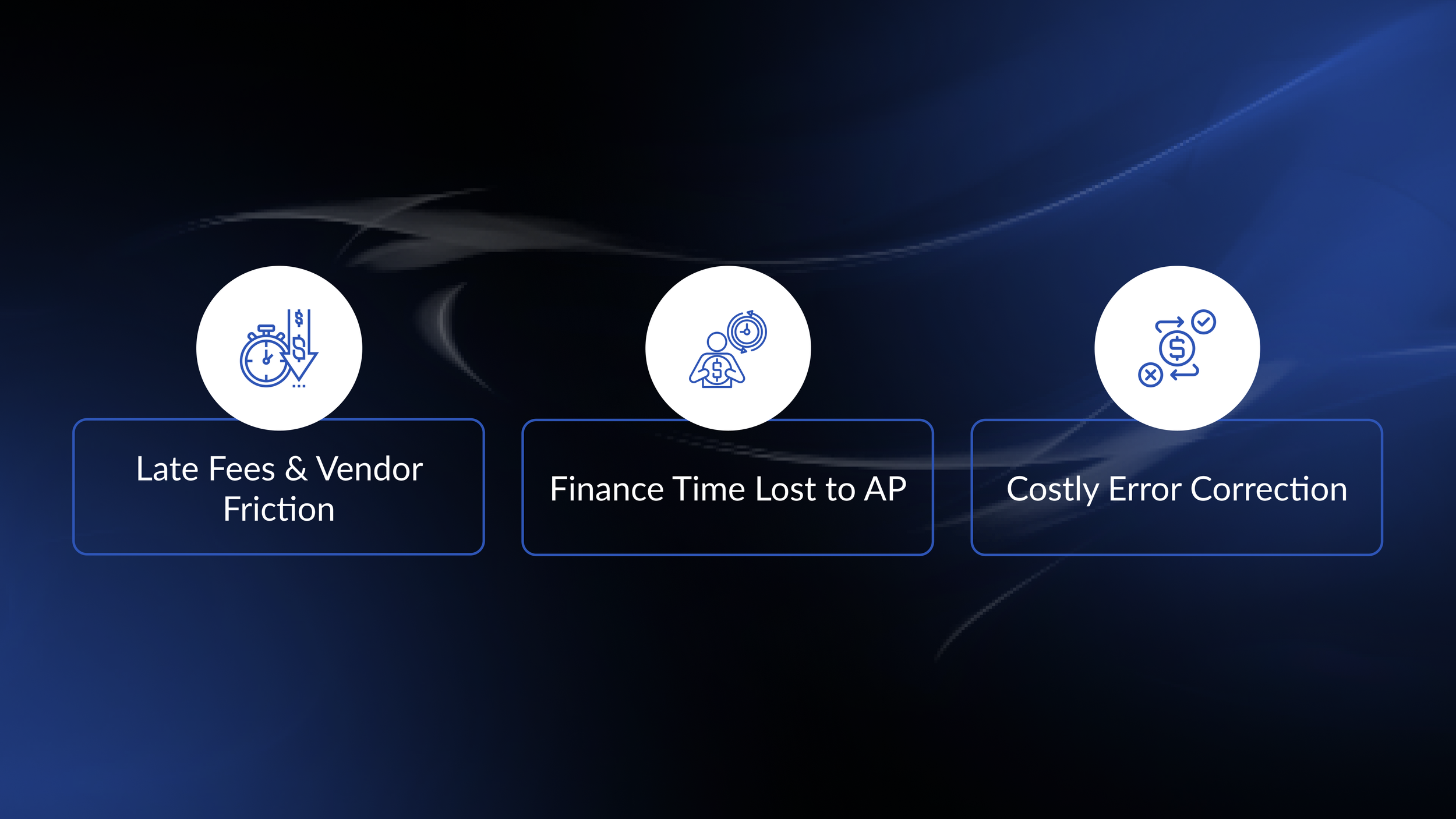
Delaying accounts payable outsourcing services doesn’t usually show up as one obvious number; the cost accumulates in places that are easy to miss:
Late Fees & Vendor Friction: Payments that slip past terms because approvals stall create real costs and friction with the vendors you depend on.
Finance Time Lost to AP: Every hour spent on manual invoice processing is an hour not spent on forecasting, analysis, or the higher-value work a growing company actually needs from its finance team.
Costly Error Correction: A miskeyed invoice or duplicate payment doesn’t just cost the error itself; it costs the time spent finding and fixing it, often weeks later.
None of these show up as a single line item on a P&L. They show up as a finance function that’s perpetually behind, even as the business around it keeps growing.
1116 Perspective | AP Is a Part of a Bigger System
Growing companies rarely outsource AP because the current setup is completely broken. They outsource because they realize AP isn’t a standalone task; it feeds directly into month-end close and financial reporting, and a messy AP process eventually shows up as a messy close.
Once you decide to outsource, the next question is usually scope. Outsourcing accounts payable services means deciding which responsibilities your external provider will handle and which will remain with your internal finance team.
What Should Stay With Your Internal Finance Team?
Outsourcing AP doesn’t mean handing over every financial decision. For most growing companies, the model that works best separates execution from authority: an external team handles invoice processing, coding, reconciliation, payment scheduling, and vendor communication, while your internal leadership keeps:
Invoice approval
Payment authorization
Vendor contracts and negotiations
Budget decisions
Cash management
Financial reporting
Accounting oversight
This is exactly how 1116 Partners structures accounts payable outsourcing services: we execute what your business has already authorized; we don’t replace the judgment calls that belong with your team. We define the exact allocation before the engagement starts based on your systems, approval structure, and internal controls, so there’s no ambiguity about who owns what.
How AP Outsourcing Supports a Growing Finance Function
| Growing Business Need | How AP Outsourcing Helps |
|---|---|
| Higher invoice volume | Adds processing capacity without immediate AP hiring |
| Limited controller capacity | Moves routine AP work away from senior finance staff |
| Poor payment visibility | Provides more consistent tracking of outstanding obligations |
| Inconsistent AP processes | Establishes defined workflows and responsibilities |
| Month-end bottlenecks | Keeps AP activity consistent throughout the month, instead of piling up before close |
| Staff turnover or absences | Provides processing continuity that doesn’t depend on one person |
| Growing financial complexity | Adds AP capacity that works alongside the broader accounting function, not apart from it |
The benefit isn’t simply having someone else process invoices; it’s building an AP function that keeps pace with the business instead of becoming a constraint on the rest of finance. That takes more than moving invoices off your team’s plate. It takes an AP function that works as part of your broader finance operation.
Build a More Efficient AP Process With 1116 Partners
Growing companies don’t usually struggle because they have too many invoices. They struggle when routine AP work starts taking time and attention away from the financial decisions that actually move the business forward.
Accounts payable outsourcing services help close that gap by taking routine AP responsibilities off your internal team’s plate while keeping approval authority, financial controls, and oversight where they belong.
With AP handled consistently, your finance team gains better visibility into cash obligations, fewer routine bottlenecks, and more capacity for forecasting, analysis, and strategic decision-making. 1116 Partners works as an extension of your finance function, giving your team more room to focus on where the business is going, not just keeping up with where it is today.
As invoice volume and vendor relationships grow more complex, many clients pair accounts payable outsourcing services withOutsourced Accounting Services,Month-End Close Services,Fractional Controller Services, andFinancial Reporting Services, so AP data flows directly into a clean close, controller-level oversight, and trusted reporting leadership.
FAQs
-
Often, yes, especially once you account for the full cost of an in-house hire (salary, benefits, training, and turnover risk) against the per-invoice cost of accounts payable outsourcing services, which scales with volume instead of requiring a fixed headcount investment.
-
No. Outsourced accounts payable services typically handle processing and routing, while your internal team retains approval authority and payment sign-off; the provider executes what your business has already authorized.
-
AP software is a tool your internal team still has to operate. Accounts payable outsourcing services provide the team that runs the process, which matters most for growing companies that don’t have spare internal capacity to manage a new system on top of everything else.
-
Yes, and it typically works best when it does. Outsourcing accounts payable services as part of a broader bookkeeping relationship keeps AP data connected to the rest of your books, instead of creating a separate system that needs to be reconciled later.
-
Most companies see measurable improvements in processing time and error rates within the first couple of months, though the full benefits, including better visibility and fewer missed discounts, tend to compound as the provider becomes familiar with your vendors and approval structure.
