

What Are Accounts Payable Services & Should You Outsource Them?
Key Takeaways
- Accounts payable services cover invoice processing, coding, approval routing, payment scheduling, reconciliation, vendor records, and supporting documentation.
- AP is an accounting process with important financial controls around invoice approval, payment authorization, and reconciliation.
- Rising invoice volume, delayed approvals, unclear payment status, and growing administrative workload are common reasons businesses consider outsourcing AP.
- Outsourcing accounts payable services shifts agreed AP tasks to an external team while your business retains oversight of approvals, payment authority, and financial decisions.
- The right AP setup depends on your invoice volume, finance-team capacity, approval structure, accounting systems, and internal controls.
Consider a situation where you approve an invoice on Monday, expect it to be paid by Friday, and then spend the following week trying to determine the payment status.
Another invoice has come through a vendor portal. A third is waiting for approval from someone who is out of the office. Your finance team knows payments are going out, but no one has a clear picture of what has been approved, what has been paid, and what is still due.
That is a common gap in a growing finance function. Accounts payable services handle invoice processing, approvals, payment scheduling, vendor records, reconciliation, and supporting documentation.
Accounts payable services cover the process of receiving, reviewing, approving, paying, and recording vendor invoices. They may be handled internally, through accounting software, or by an external provider, depending on the business, its invoice volume, internal finance capacity, and the provider’s scope.
As invoice volume grows, managing payments and approvals takes more time from your finance team.
In this blog, we’ll explain what accounts payable services include, how the accounts payable (AP) process works, and when outsourcing accounts payable services is worth considering for your business.
What Are Accounts Payable Services?
Accounts payable services cover the activities involved in managing what a business owes its vendors and suppliers. This includes handling invoices, recording them in the books, securing the required approvals, processing payments, and maintaining accurate related records.
The scope depends on how a business manages AP. Some businesses manage AP internally using accounting software and in-house staff; others use accounts payable outsourcing services to handle part or all of the function through an external accounting team.
The scope includes some combination of:
Invoice receipt and processing
Invoice coding
Approval workflows
Vendor management
Payment scheduling
Payment processing
Reconciliation
AP reporting
Documentation and recordkeeping
Providers differ in how much of this they cover. Some focus narrowly on invoice processing, approvals, and payment execution with the client. Others manage the full cycle, including vendor communication and month-end reporting.
Before assuming a provider handles a task, ask directly what’s included in their scope of work.
How Do Accounts Payable Services Work?
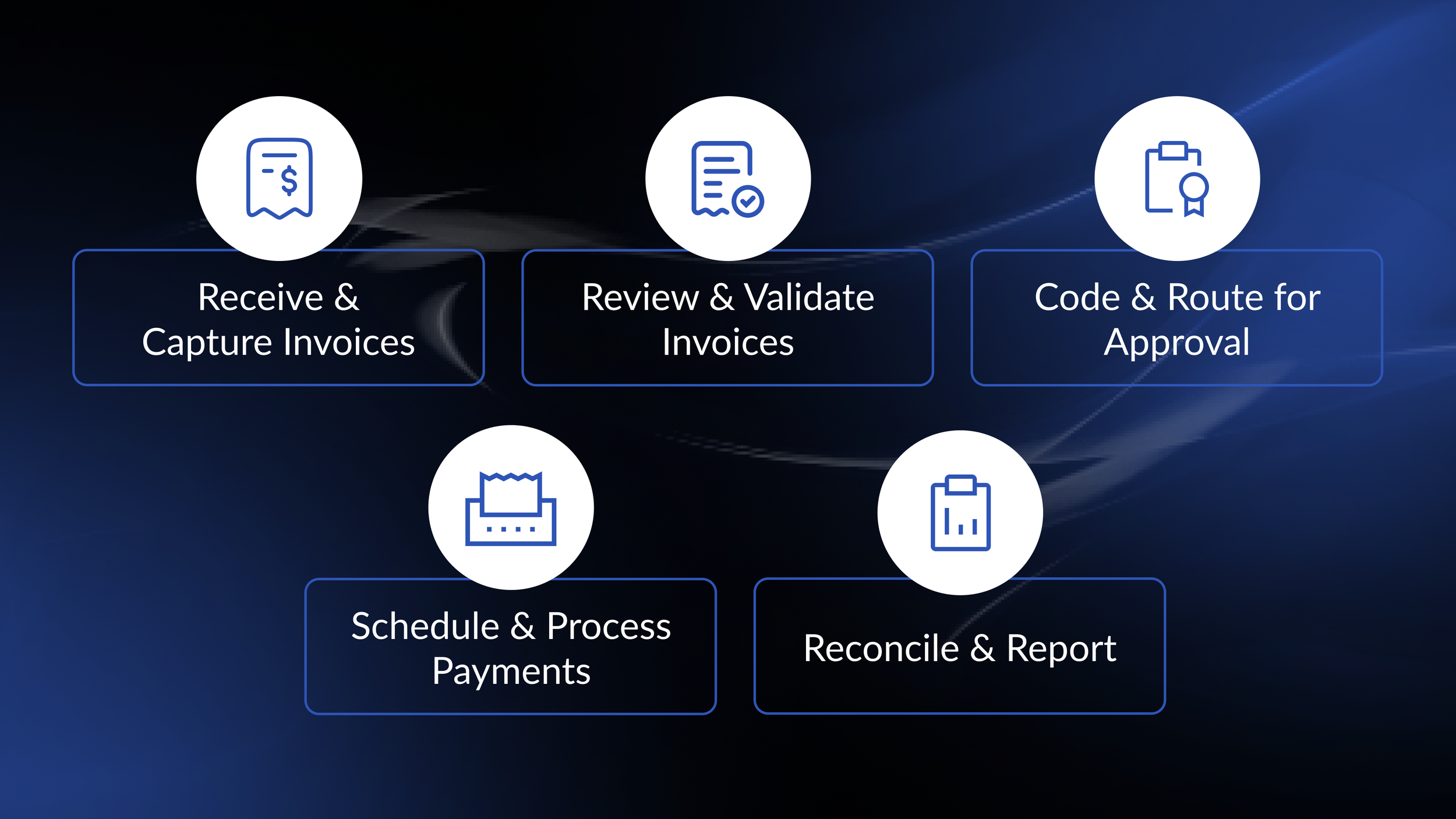
The AP process usually follows five basic steps. Your internal team or an outside provider can handle the process:
Receive & Capture Invoices: Invoices arrive via email, mail, or the vendor portal and are logged in a system so nothing sits unaccounted for in someone’s inbox.
Review & Validate Invoices: Each invoice is checked against a purchase order or prior agreement, screened for duplicates, and confirmed against a known vendor before it moves forward.
Code & Route for Approval: The invoice is assigned to the correct general ledger account, cost center, or project, then sent to the appropriate approver based on amount or department.
Schedule & Process Payments: Payments are scheduled per vendor terms, using the appropriate method (ACH, check, or card), balancing on-time payment with cash flow needs.
Reconcile & Report: Payments are matched to invoices and bank activity, and AP aging reports provide leadership with a current picture of what’s outstanding.
The exact process depends on the company’s systems, invoice volume, and internal controls. Some steps are automated, while others still require manual review.
Each of these steps also functions as a control point. Payment fraud remains a real risk for businesses of every size — the Association for Financial Professionals reported that 79% of organizations experienced attempted or actual payment fraud in 2024, most commonly through business email compromise.
Invoice verification, approval routing, and reconciliation each help reduce that risk, which is why AP is treated as an accounting process with real controls, not just a task list.
1116 Perspective | What Comes Up Most Often in AP
Processing an invoice is only one part of AP. The coding, approval, payment, reconciliation, and reporting that follow affect the accuracy of the wider accounting records. A provider handling AP should understand the connection and the associated accounting responsibilities.
In-House vs. Outsourced Accounts Payable
The choice between in-house and outsourced AP comes down to capacity, control, and how the function fits into your broader finance team:
| Factor | In-House AP | Outsourced Accounts Payable Services |
|---|---|---|
| Staffing | Requires internal hiring, training, and coverage | AP responsibilities are handled by an external team |
| Invoice processing | Depends on internal staff capacity | Follows an established external process |
| Approval management | Managed through internal procedures | Follows agreed approval rules and thresholds |
| Payment scheduling | Managed by internal finance staff | Coordinated with vendor terms and client payment rules |
| Staff coverage | Absences and turnover affect capacity | External team provides ongoing service coverage |
| Internal oversight | Responsibilities stay inside the company | Leadership retains agreed approval and payment authority |
| Management time | Owners or controllers may remain involved in routine AP | Routine AP execution shifts to the provider |
| Best fit | Lower invoice volume and simple AP requirements | Growing volume, limited internal capacity, or more involved AP requirements |
Before making the switch, plan the transition: clearly divide responsibilities, allow time to configure systems and access, and review provider fees against your actual invoice volume. Security, access, and payment controls also deserve careful review regardless of which model you choose.
Who Typically Uses Outsourced Accounts Payable Services?
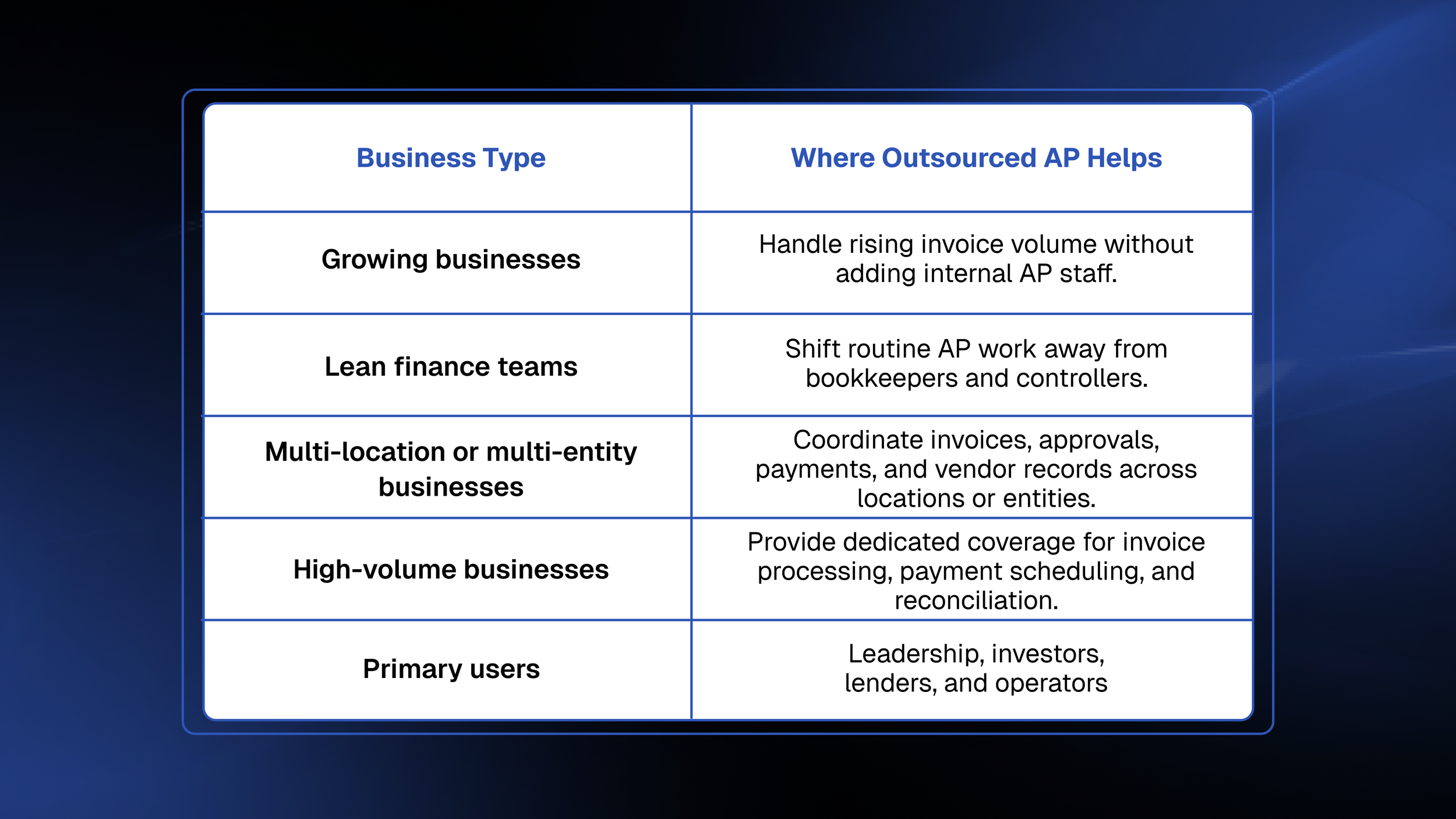
Outsourced AP tends to show up most often in a few recognizable situations: businesses with growing invoice volume relative to their finance team size, companies managing multiple entities or locations, and organizations that need consistent AP coverage regardless of staff turnover or absences. The right fit depends less on company size and more on how AP volume compares to available finance-team capacity.
1116 Perspective | The Right Role of Outsourcing
Outsourcing AP becomes more useful when transaction volume begins to compete with the finance team’s higher-value work. The right model takes the transaction load off your team while leaving financial decisions and control in the hands of your internal leaders.
What Should You Look for in an Accounts Payable Services Provider?
Once a business decides to outsource, the next step is to evaluate how a provider will handle the work.

Look for:
Defined Scope of Work: Get a written list of the AP tasks included in the service.
Accounting Knowledge: The provider should understand GL coding, reconciliations, accruals, and how AP fits into the broader books.
Approval Controls: Ask how invoices move through the approval process and which decisions your internal team makes.
Payment Authority: Confirm who initiates payments, who authorizes them, and how those responsibilities are separated.
Accounting System Compatibility: Check that the provider has experience with your accounting platform and AP systems.
Reporting: Ask which AP reports you receive, how often they arrive, and what information they contain.
Security & Access Controls: Confirm how the provider protects vendor information, banking details, credentials, and payment permissions.
Service Coverage: Understand who handles the account when the primary contact is unavailable.
Communication Process: Establish who handles vendor questions, disputed invoices, urgent payments, and internal requests.
Pricing Structure: Review what the quoted fee includes and which services or transaction volumes carry additional charges.
Before signing an agreement, ask the provider to walk through a typical invoice, including your approval and payment requirements. That gives your finance team a practical view of how the service will fit into its existing process.
Why AP Accuracy Affects More Than Just Payments
An invoice error rarely stays contained to a single transaction. Incorrect coding flows into the general ledger. A missed or duplicate payment distorts cash reporting. An unreconciled balance can delay month-end close, turning a routine AP task into extra work for the whole accounting team.
This is why AP shouldn't be evaluated as a standalone task, whether it's handled internally or by an external provider. The quality of your AP process directly affects the reliability of your broader financial records, which is exactly why a provider's accounting knowledge matters as much as their processing speed.
Bring Expert-Level Control to Your Accounts Payable With 1116 Partners

AP errors rarely stay confined to an invoice. Incorrect coding, missed payments, or unreconciled balances can affect the general ledger, cash reporting, and month-end close.
1116 Partners brings Controllers and Senior Accountants into the accounting function, supporting AP, reconciliations, general ledger management, financial reporting, cash flow reporting, and month-end close. This gives your finance team AP support backed by the accounting expertise needed to keep the records accurate.
For growing businesses, lean finance teams, and multi-entity companies, 1116 Partners provides additional accounting capacity without separating AP from the rest of the books.
FAQs
-
The timeline depends on invoice volume, accounting systems, approval rules, vendor records, and payment responsibilities. A transition typically involves documenting the existing AP process, assigning responsibilities, configuring system access, and testing invoice and payment workflows before regular processing begins.
-
Your internal team typically retains approval authority, while the provider handles the AP tasks assigned in the service agreement. Document approval thresholds, authorized approvers, payment authority, and escalation procedures before processing begins.
-
The provider may handle routine vendor inquiries, invoice questions, payment status requests, and disputed invoices when these responsibilities are included in the accounts payable service. Your internal team can retain responsibility for vendor negotiations, purchasing decisions, contracts, and other supplier relationships.
-
Useful AP measures include invoice processing time, invoices awaiting approval, AP aging, exception rates, duplicate payments, and on-time payment performance. Reviewing these measures regularly gives finance leaders a clearer view of processing volume, delays, outstanding obligations, and control issues. AP providers commonly use cycle time, accuracy, aging, exception trends, and related measures to assess performance.
-
Yes. Outsourced accounts payable services can handle defined processing responsibilities while your internal finance team retains approval authority, payment decisions, financial oversight, and other accounting responsibilities. The division of responsibilities should be established before you outsource accounts payable services, particularly when the finance team already manages the general ledger and month-end close.
