

Key Takeaways
- Accounting and taxation services serve different purposes: one tracks financial performance; the other manages tax compliance and liability.
- Accounting runs continuously throughout the year; tax work is periodic, tied to filing deadlines and estimated payments.
- Accounting follows GAAP; tax and accounting services follow the tax code, a completely separate set of rules.
- Strong accounting and reliable tax outcomes depend on each other; accurate books make tax filing accurate, and tax planning works best when it’s informed by real-time financials.
- Most growing businesses need both accounting and tax services working together, not one instead of the other.
Let’s say you hire a bookkeeper in January, feel good about your books by summer, and still get blindsided by a tax bill in April.
It’s one of the most common gaps in a growing business, and it rarely comes down to anything you or your team did wrong. Accounting and taxation services solve two different problems, on two different timelines, and you’ve probably only staffed for one of them.
Accounting and taxation services often get bundled together in conversation, but they’re not the same discipline. Accounting is the ongoing work of recording, organizing, and reporting on your finances. Tax is the periodic work of complying with tax law and managing what you owe.
Confusing the two, or assuming one automatically covers the other, is exactly how you end up with trustworthy books and still get hit with an ugly tax surprise.
In this blog, we’ll break down the fundamental differences between accounting and tax services, explain why they matter, and help you determine whether your business needs one, the other, or both.
What is the Difference Between Accounting and Tax Services?
Although they’re often mentioned together, accounting and tax services serve different purposes within a business. They rely on the same financial information, but they’re designed to answer different questions, follow different rules, and support different business objectives.
Understanding how these accounting and taxation services differ helps businesses make better financial decisions while staying compliant.
Accounting
Accounting is the ongoing practice of recording transactions, reconciling accounts, and producing financial statements that reflect how a business is actually performing. In the U.S., these financial statements are typically prepared under GAAP (Generally Accepted Accounting Principles), the standard set by the FASB (Financial Accounting Standards Board).
Publicly traded companies must also follow SEC reporting rules, whereas most private businesses follow GAAP only if a lender, investor, or board requires it.
Accounting is built for continuous use; leadership, investors, and lenders all rely on this data to make decisions in real time, not just once a year.
Accounting is designed to answer one fundamental question: “How is the business performing today, and where is it headed?”
Tax Services
Tax services focus on compliance with U.S. tax law: preparing and filing federal returns with the IRS (and often state returns, since state tax rules vary considerably), calculating what’s owed, identifying deductions and credits, and planning strategies to legally reduce tax liability under the Internal Revenue Code.
Unlike accounting, tax work is periodic and deadline-driven; annual returns are typically due each spring, but many businesses also owe quarterly estimated tax payments throughout the year.
Depending on the entity structure (sole proprietorship, S-corp, C-corp, partnership, or LLC), the applicable tax forms and filing requirements can differ significantly, which is exactly why tax rules don’t map cleanly onto a single, uniform accounting process.
Tax services answer a different question: “What does the business owe, and how can it remain compliant while minimizing tax exposure?”
Where the Confusion Comes From
The confusion between accounting and tax services usually comes from the fact that both rely on the same underlying financial data; they just use it for different purposes, on different timelines, and are governed by entirely different rule sets: GAAP for accounting and the Internal Revenue Code (plus applicable state tax law) for tax.
1116 Perspective | What We See Most Often
The businesses that get burned aren’t the ones without a good bookkeeper or a good CPA. They’re the ones where the two never actually talk to each other.
6 Core Differences Between Accounting and Tax Services
Accounting and tax services complement one another, but they’re far from interchangeable. The six differences below explain how each function supports your business in a distinct way.
1. Purpose
Accounting: Gives leadership an ongoing picture of financial health, the same data lenders use to check loan covenants, and investors use to evaluate performance.
Tax: Keeps the business compliant with the Internal Revenue Code and state tax law, while managing what’s owed to the IRS and state Departments of Revenue.
This is the core difference between accounting and taxation services: one is about understanding the business; the other is about meeting a legal obligation.
2. Timing & Frequency
Accounting: Books are updated monthly, sometimes daily, to keep the numbers up to date.
Tax: Filed periodically, typically an annual return, plus quarterly estimated payments for many businesses.
Annual filing deadlines vary by entity type and typically fall in Q1; deadlines can shift slightly around weekends or holidays, and extensions are common.
3. Scope of Work
Accounting: Bookkeeping, reconciliations, financial statement preparation, and month-end close.
Tax: Return preparation tied to entity structure, plus entity structuring, credits, deductions, and tax-reduction strategies. Tax return preparation varies significantly depending on how your business is structured — a sole proprietor’s filing looks nothing like a multi-entity company’s.
Accounting tax services and day-to-day bookkeeping require two entirely different skill sets, even when both draw from the same books.
4. Governing Standards
Accounting: Follows GAAP, set by the Financial Accounting Standards Board (FASB).
Tax: Follows the Internal Revenue Code and IRS regulations, a separate set of rules that doesn’t always align with GAAP.
Example: an asset can be depreciated one way for financial reporting and a different way for tax purposes. That’s why a GAAP statement and a tax return can legitimately show different numbers for the same asset in the same year — it’s not an error; it’s two different sets of rules doing their jobs.
5. Deliverables
Accounting: P&L, balance sheet, and cash flow reports, prepared under GAAP.
Tax: Filed tax returns, plus Schedule K-1s for pass-through entities like S-corps and partnerships.
Both are essential, and neither replaces the other, which is exactly why tax and accounting services are usually staffed as separate functions.
6. Who Uses the Output
Accounting: Leadership, investors, and lenders evaluating covenants or investment decisions.
Tax: Primarily the IRS and state Departments of Revenue, sometimes lenders or investors requesting filed returns during due diligence.
Different audience, different definition of ‘accurate’: GAAP-accurate for accounting, tax-code-accurate for tax.
A Quick Look at Accounting vs. Tax Services
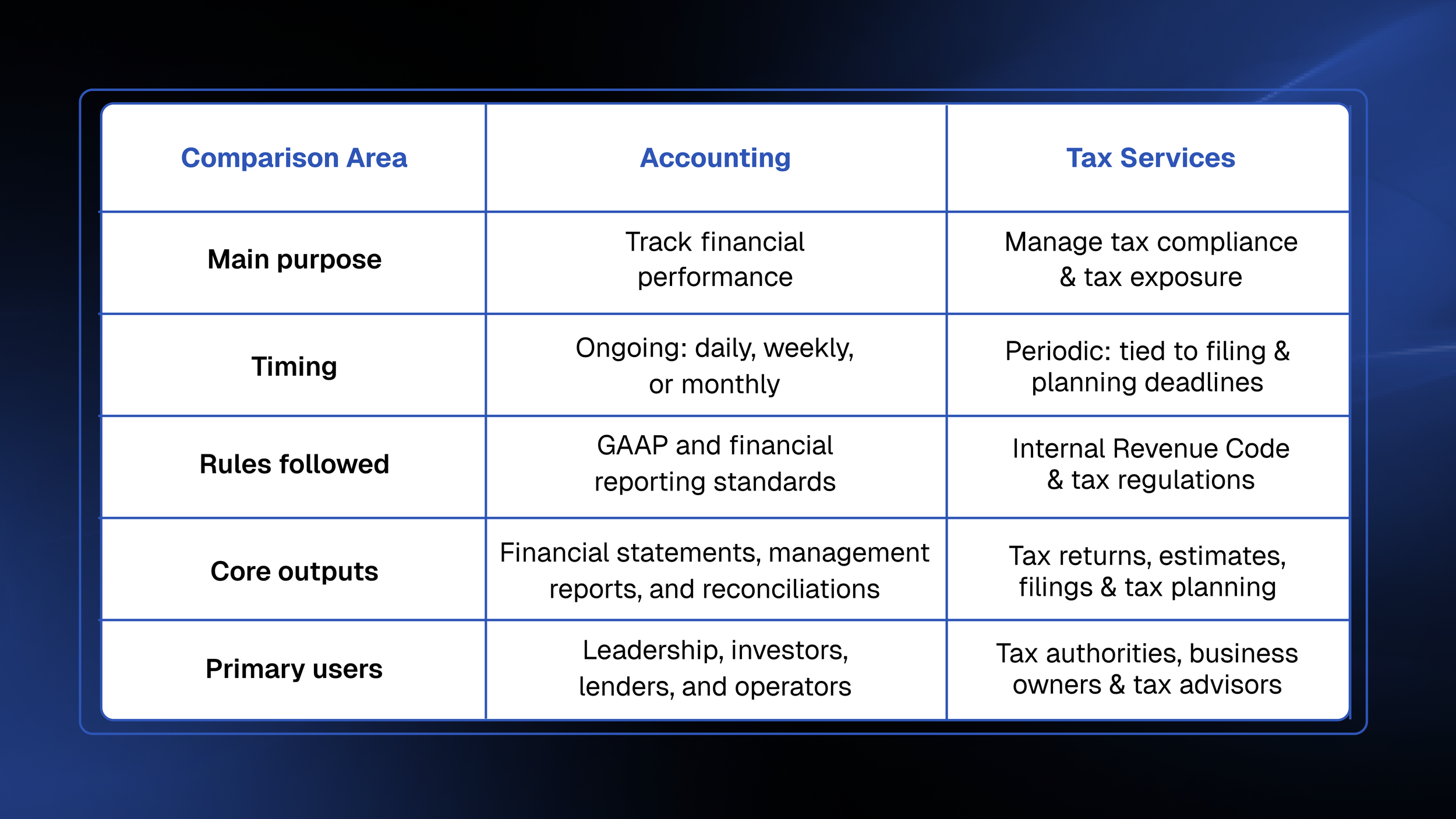
The table below breaks down how accounting and taxation services differ across purpose, frequency, and the rules each one follows:
Accounting and Tax Services: When Do You Need Both?
The short answer: most growing businesses need both, running at the same time, not one instead of the other.
Strong accounting creates the foundation for good tax work — but accounting and tax remain distinct functions, run on different timelines, by different people, under different rules. Almost every growing business needs its accounting and its tax work to work together, even when they come from two different specialists. Meticulous, accurate books make tax filing faster and more accurate, and tax planning only works when it’s based on real financial data, not a rough estimate pulled together the week before a deadline.
Businesses that run into trouble usually treat these as interchangeable, assuming a bookkeeper handles tax strategy or that a CPA who files an annual return also keeps the books up to date throughout the year. In most cases, neither assumption is true, and the gap between them is where surprises happen.
It’s a common misconception that accurate books automatically lead to tax efficiency. In reality, accounting provides the financial foundation, while tax preparation determines how that information gets applied under tax law. Together, they create a finance function that’s both operationally sound and fully compliant.
When Accounting & Tax Both Need to Be a Priority

Whatever stage your business is at, the table above points to the same conclusion: accounting and tax aren’t a choice between two services; they’re two halves of one finance function. The businesses that treat them that way spend less time reacting to surprises and more time making decisions with numbers they actually trust.
Build Financial Clarity & Tax Confidence With 1116 Partners

Accurate books and a sound tax strategy shouldn’t operate on separate tracks, yet for most growing businesses, that’s exactly what happens. 1116 Partners closes that gap from the accounting side. We handle monthly reconciliations, accurate reporting, and tax-ready books all year, so when your CPA sits down to file, they’re working from structured, current financials instead of reconstructing months of activity under deadline pressure.
We don’t replace your tax advisor. We make sure they never start all over again.
Whether you’re a founder just getting your first system in place, a growing SaaS or e-commerce business outgrowing a single bookkeeper, or a multi-entity company juggling accounting across every subsidiary, we build accounting support around your business needs & growth stage.
FAQs
-
It can work well when the two are closely coordinated, even if they’re handled by different specialists. 1116 Partners focuses on keeping your accounting accurate and tax-ready year-round and works directly with your CPA or tax advisor so nothing gets lost in the handoff at filing time.
-
Usually, yes. A bookkeeper maintains accurate financial records, but tax filing, credits, deductions, and tax strategy typically require a dedicated tax professional. What a bookkeeper alone usually can’t provide is the ongoing accounting accuracy that makes that tax work efficient; that’s the gap 1116 fills.
-
Financial statements follow GAAP, while tax returns follow the tax code. Since the two frameworks treat certain transactions differently, it’s normal for the numbers not to match exactly.
-
Once revenue, entity structure, or transaction complexity grows beyond what a generalist can confidently handle, or ahead of any major event such as fundraising, an acquisition, or expansion into a new state. 1116 Partners works with businesses at exactly this inflection point, ensuring your accounting is audit- and investor-ready before a major event, so your tax advisor isn’t starting from a mess.
-
Yes. Tax filing is the annual compliance requirement; tax planning is the ongoing strategy throughout the year, aimed at legally reducing what a business owes before the filing deadline.
