

Key Takeaways
- SaaS accounting recognizes subscription revenue as it’s earned, not when cash is collected.
- ASC 606 governs SaaS revenue recognition under U.S. GAAP through a five-step framework.
- Deferred revenue, MRR, ARR, and churn are core metrics for tracking and reporting SaaS finances.
- Bookings, billings, and revenue are three distinct SaaS metrics that are often confused.
- Financial needs evolve as a SaaS company grows; the right support at the seed stage looks different from what’s needed pre-Series B.
Let’s say a SaaS company has just crossed its first $1 million in Annual Recurring Revenue (ARR). The spreadsheet that got them there has worked perfectly until a board member asks, “How much of this quarter’s revenue is actually deferred?” Suddenly, no one in the room has a confident answer.
That moment arrives more unexpectedly than many founders anticipate. The finance function that gets a SaaS company to its first million in ARR rarely supports the journey to the next ten.
It’s rarely a failure of effort. In the early stages, accurate bookkeeping and basic accounting are enough. But as the business grows, subscription models become more complex, recurring revenue expands, and investors expect deeper financial visibility.
That’s where software as a service (SaaS) accounting comes in. Built for subscription-based businesses, it helps manage recurring revenue, revenue recognition, deferred revenue, and financial reporting, giving leadership the clarity to scale with confidence.
Whether you’re preparing for your first funding round, expanding into new markets, or building a stronger finance function, understanding SaaS accounting is what lets you answer the board’s questions with confidence instead of a shrug. This blog breaks down exactly what you need to know.
What Is SaaS Accounting?
SaaS accounting, also called accounting for software as a service, is a specialized discipline that reflects how subscription revenue actually behaves rather than treating every payment as immediately earned. It governs how a business records revenue, tracks liabilities, and reports performance when customers pay for a service delivered gradually over time.
In short, SaaS accounting isn’t “regular bookkeeping with software”; it’s built around the reality that a customer’s payment today might represent months or years of service still to be delivered.
1116 Perspective
One of the biggest misconceptions we see is that accounting becomes more important as a company grows. In reality, finance becomes more important. Accounting records what happened. Finance explains why it happened, what it means, and what leadership should do next.
Why SaaS Accounting Requires a Different Approach
SaaS accounting exists because subscription revenue behaves differently from a one-time sale; a customer who pays $1,200 upfront for an annual plan hasn’t actually earned you that revenue yet. It’s earned gradually, month by month, as the service is delivered. That single fact reshapes how revenue, billing, and customer relationships get recorded, which is why SaaS accounting has developed into its own specialized practice rather than a variation on standard bookkeeping.
Running a growing business today requires more than a great product; it requires a finance function that moves at the same pace. Accenture found that CFOs with real-time, predictive visibility consistently outperformed growth expectations, with the potential to nearly double EBITDA growth. That’s the kind of advantage that accurate, current data creates and the foundation that SaaS accounting provides.
For a full breakdown of how SaaS accounting differs from traditional accounting, including revenue recognition timing, MRR/ARR, and how customer relationships change the books, see: SaaS Accounting vs. Traditional Accounting.
The 1116 Growth Framework: Matching Financial Support to Your Stage
Financial needs don’t stay constant as a SaaS company grows; what’s sufficient at the seed stage becomes a liability by Series B. Rather than treating accounting as a single, static service, it’s more useful to think of it as a progression:

Each stage builds on the one before it; businesses typically add structure and oversight rather than replacing what’s already working. Knowing where your company sits on this progression is often the fastest way to identify what kind of financial support will actually move the needle right now.
4 Core Principles of SaaS Accounting
Subscription revenue behaves differently from a one-time sale, and these four principles are what make SaaS accounting its own discipline rather than a variation on standard bookkeeping.
1. Revenue Recognition (ASC 606)
Under ASC 606, SaaS companies must recognize subscription revenue ratably over the contract term rather than all at once when cash is collected. This is the U.S. GAAP standard governing revenue recognition, and it applies directly to how SaaS accounting treats prepaid subscriptions.
ASC 606 breaks revenue recognition into five steps:
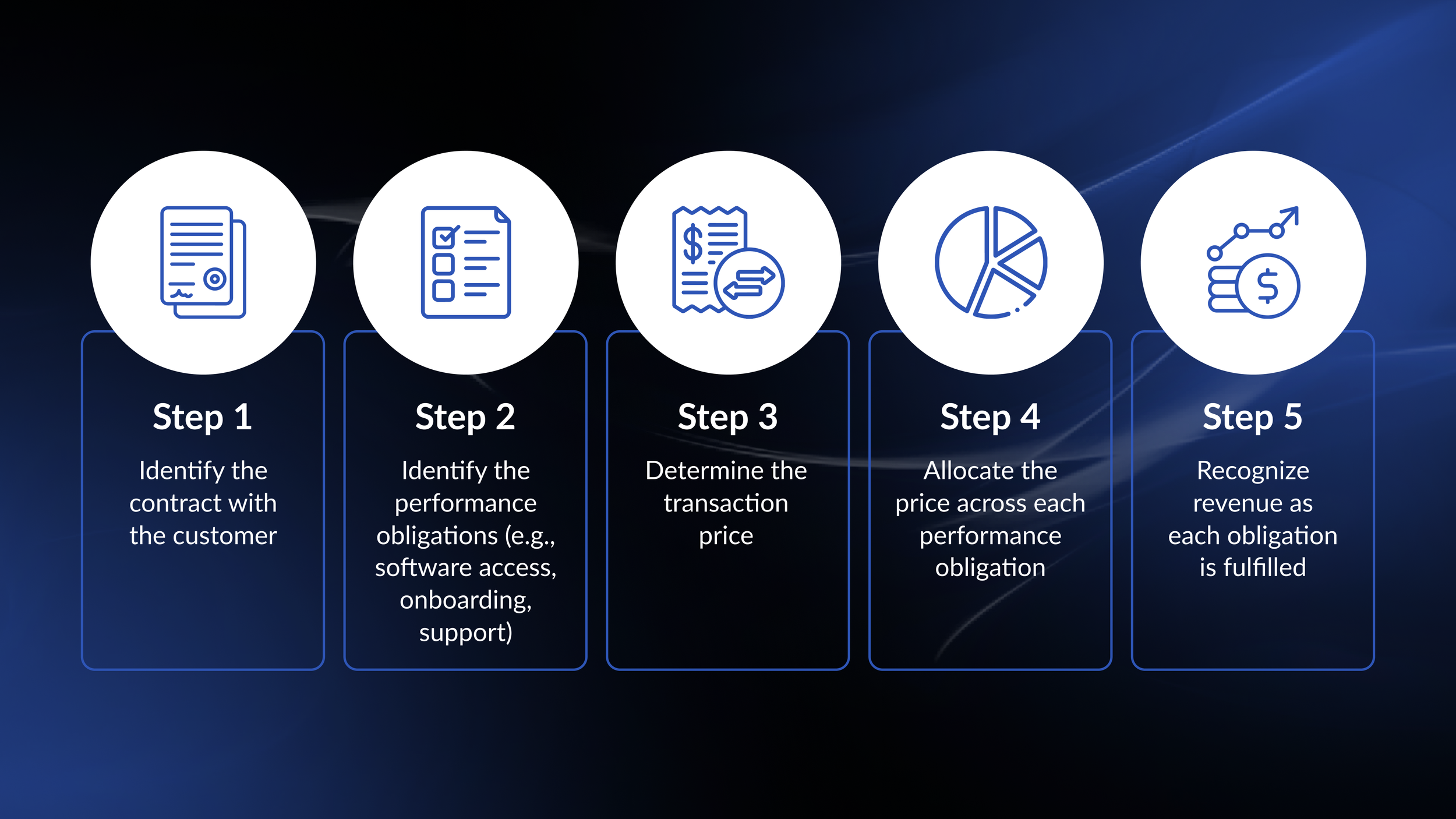
Step 1: Identify the contract with the customer
Step 2: Identify the performance obligations (e.g., software access, onboarding, support)
Step 3: Determine the transaction price
Step 4: Allocate the price across each performance obligation
Step 5: Recognize revenue as each obligation is fulfilled
Getting this wrong doesn’t just create inconsistent books; it can also misrepresent your company’s financial health to investors, lenders, or acquirers.
2. Bookings, Billings & Revenue
SaaS companies typically track three related but distinct figures:
Bookings — the total value of contracts signed
Billings — the amounts actually invoiced to customers
Revenue — the portion earned and recognized under ASC 606
A company might book a $120,000 annual contract, bill it in quarterly installments, but recognize only 1/12 of it as revenue each month, which is exactly why SaaS accounting treats these as separate metrics rather than interchangeable terms.
3. Deferred Revenue
Deferred revenue is the portion of a customer’s payment that hasn’t been earned yet, and it sits on the balance sheet as a liability until it’s recognized. If a customer prepays for a year of service, most of that payment is deferred and recognized gradually over the subscription term. Accurately tracking deferred revenue is one of the most commonly mismanaged aspects of SaaS accounting.
4. Cost of Goods Sold (COGS) & Churn
SaaS COGS typically includes hosting, service-delivery support, and third-party software costs; getting it right directly affects gross margin, one of the most closely watched SaaS metrics. Churn carries its own accounting weight, from revenue reversals to deferred revenue forecasting. It’s typically calculated as:
Churn Rate = (Customers Lost ÷ Total Customers at Start of Period) × 100
1116 Perspective
The businesses that scale most efficiently aren’t necessarily the ones with the largest finance teams; they’re the ones with financial systems that give leadership timely, reliable information. Better reporting leads to better decisions, and better decisions compound.
Benefits of SaaS Accounting for Growing Companies
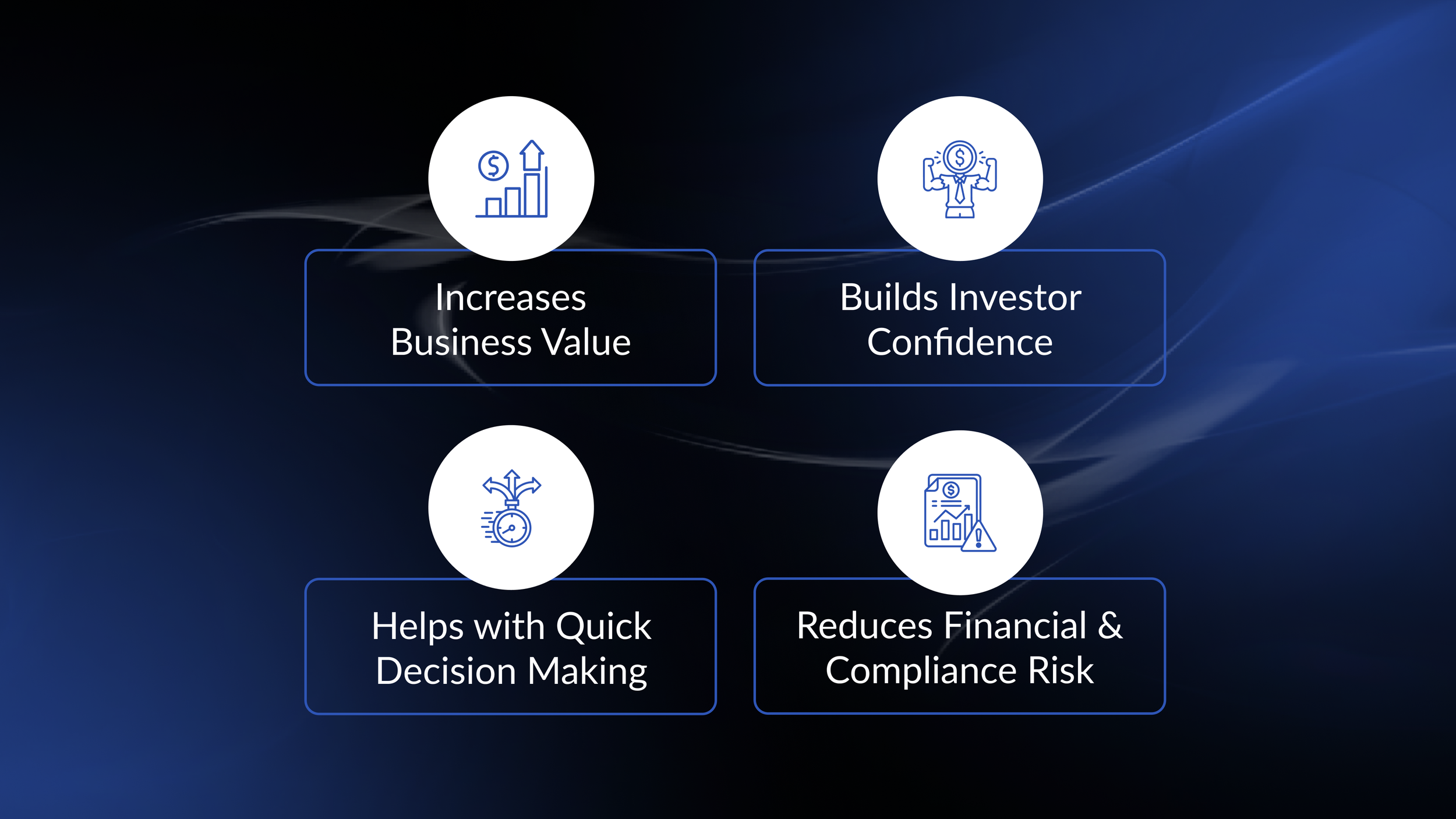
Getting revenue recognition, deferred revenue, and reporting right isn’t just about compliance; it delivers measurable advantages as a company scales.
Increases Business Value
Financial performance isn’t judged on growth alone. Investors and acquirers also evaluate the quality and reliability of your financial data. Accurate revenue recognition, clean retention metrics, and consistent reporting make it easier to assess business performance and reduce uncertainty during due diligence.
Builds Investor Confidence
Investors evaluate more than growth. Before writing a check, they expect leadership teams to explain recurring revenue, deferred revenue, customer retention, and cash performance with confidence.
A well-managed SaaS accounting function helps answer those questions with reliable data, making fundraising conversations more productive and demonstrating that the business is built for long-term growth.
Helps with Quick Decision Making
Leadership decisions are only as good as the information behind them. APQC’s benchmarking shows top-quartile finance teams close in six days versus the median’s ten, and faster, more accurate reports give leaders more runway to spot trends, respond to risks, and plan investments before opportunities pass. Instead of waiting weeks for numbers, decision-makers can act on ones they trust.
Reduces Financial & Compliance Risk
Applying ASC 606 consistently and maintaining accurate deferred revenue schedules strengthen financial reporting and reduce the likelihood of reporting errors, audit issues, or complications during investor due diligence. As your business grows, these controls become increasingly important for protecting both credibility and valuation.
Common Accounting Challenges for SaaS Companies
As SaaS businesses grow, accounting becomes more complex. Subscription billing, recurring revenue, and evolving reporting requirements can quickly outgrow the processes that worked in the early stages.
Common challenges include:
Managing deferred revenue accurately
Applying consistent revenue recognition across subscription plans
Tracking key SaaS metrics like MRR, ARR, and churn
Producing timely, decision-ready financial reports
Staying prepared for audits, fundraising, and investor due diligence
Left unresolved, these issues can delay reporting, reduce financial visibility, and make it harder to scale with confidence.
When to Bring In SaaS Accounting Support?
If your books are up to date and your reports answer the questions you need, bookkeeping may be enough for now. But as your business grows, it’s time to evolve your finance function if:
You’re not confident that your revenue recognition complies with ASC 606.
Your deferred revenue balance is more of an estimate than a calculation.
You can’t easily report on MRR, churn, gross margin, or other key SaaS metrics.
You’re preparing for fundraising, an audit, or board reporting and need investor-ready financials.
Most SaaS companies don’t reach this point overnight. The signs appear gradually until the gap between what the books show and what’s happening in the business becomes impossible to ignore. The strongest finance teams act on the first signs, not the last.
That’s where specialized SaaS accounting adds value, helping you build the processes, controls, and reporting needed to scale with confidence.
Build a Strong SaaS Financial Foundation With 1116 Partners
Accurate revenue recognition, clean deferred revenue tracking, and reporting that reflects how your SaaS business actually performs — that’s what SaaS accounting is for.
1116 Partners works as an extension of your leadership team, offering Outsourced Accounting Services, Month-End Close Services, Fractional Controller Services, and Fractional CFO Services as your business grows through each stage.
Whether you’re just building recurring revenue or preparing for your next raise, we meet you at your stage and grow with you.
FAQs
-
SaaS accounting is the specialized practice of managing financial records, revenue recognition, and reporting for subscription-based software businesses, accounting for recurring revenue, deferred revenue, and SaaS-specific metrics that traditional accounting doesn’t address.
-
Both follow the same underlying accrual accounting principles. The difference is complexity: subscription businesses generate significantly more recurring revenue, deferred revenue, contract modifications, and performance-obligation questions than a typical one-time sale, which is why SaaS accounting applies ASC 606 with far more nuance — tracking MRR, ARR, churn, and deferred revenue schedules a simpler, transaction-based business rarely needs.
-
ASC 606 is the U.S. GAAP standard governing how and when revenue should be recognized. For SaaS companies, this generally means recognizing subscription revenue gradually over the contract term rather than recognizing it all at once upon receipt of payment.
-
Yes. Even early-stage SaaS companies benefit from accounting practices that properly handle deferred and recurring revenue metrics, issues that are far easier to fix early on than after years of inconsistent bookkeeping.
-
Outsourcing typically makes sense when a company needs SaaS-specific expertise, is preparing for fundraising or an audit, or wants accurate reporting on metrics like MRR, churn, and gross margin without building an internal finance team.
