On July 1, a SaaS company signed a three-year, $360,000 contract with a $15,000 setup fee, both paid upfront. Six months later, it has collected $375,000, but only $62,500 of that cash counts as revenue. The customer has also incurred $1,800 in usage that hasn’t been invoiced.
So how should the finance team book the setup fee, the unbilled usage, and the prepayment?
Accounting for SaaS contracts like this follows ASC 606: revenue is recognized as services are delivered, not when cash arrives. Setup fees that don’t deliver a separate service are usually spread over the term, usage is recognized as it occurs, and prepayments sit in deferred revenue until earned.
Contracts like this are increasingly common as pricing moves beyond per-seat subscriptions. A PitchBook analyst note highlights the shift toward selling outcomes rather than seats, while vendors explore hybrid plans, prepaid credits, and usage-based fees.
This blog follows the contract stage by stage, showing how each element affects revenue recognition.
Key Takeaways
- Accounting for SaaS follows ASC 606 regardless of the contract terms: revenue is recognized as services are delivered, not when an invoice goes out or cash arrives.
- Recognize a setup fee over the subscription term unless the setup work delivers a separate service the customer can use on its own.
- Usage charges are generally recognized in the period the usage occurs, which creates unbilled revenue whenever invoicing lags consumption.
- A multi-year prepayment sits in deferred revenue and splits between current and long-term, depending on when the service will be delivered.
- Every stage of a contract raises a question a reviewer will ask, so each judgment needs a documented assessment and supporting evidence.
How Does Accounting for SaaS Work Across the Life of a Contract?
Accounting for SaaS starts with the five-step model in ASC 606, which the FASB set out in ASU 2014-09: identify the contract, identify the performance obligations, determine the transaction price, allocate the price, and recognize revenue as each obligation is satisfied.
A flat monthly subscription needs little judgment after step one. SaaS revenue recognition gets harder when a contract adds setup, usage, and a long term, because each one changes what was promised, what will be paid, or when the service is delivered.
The contract used throughout this blog:
Term: 36 months, starting July 1
Subscription: $360,000 prepaid at signing, or $10,000 of revenue a month
Setup Fee: $15,000, paid at signing
Usage: a monthly allowance, with overage billed in arrears
Each stage below shows what the books record for SaaS contracts and what a reviewer will ask.
What Happens at Signing?
Signing is where core accounting decisions begin. For SaaS setup fees, the first question is whether the setup work provides a distinct service the customer can use independently.
Configuration, data migration, and account setup usually help customers access the subscription. Under ASC 606, these activities generally don’t create a separate performance obligation, so you recognize the fee over the subscription term rather than when setup is complete.
For related journal entries, check out our blog on service revenue in accounting.
Custom integrations or standalone training may qualify as distinct services, allowing the fee to be recognized as the work is delivered.
What a Reviewer Will Ask
Why spread the setup fee over 36 months instead of recognizing it when the work finished?
What Evidence Do You Need?
A written assessment of the setup work, the contract language, and a description of what the customer received.
What Happens at Invoicing & Payment?
When the customer pays, nothing has been earned yet. The cash is recorded as deferred revenue, a liability, and it moves into revenue as the service is delivered. For how a simple subscription is booked, see What Is Software Revenue Recognition? SaaS Costs Explained.
At payment: Debit cash $375,000, then credit deferred revenue $360,000 for the subscription and $15,000 for the setup fee.
A multi-year contract doesn’t change when revenue is earned. It changes how much sits in deferred revenue and how that balance is presented. The same $360,000 subscription looks like this at December 31 under three billing patterns:
| Billing Pattern | Billed at Signing | Revenue by Dec 31 |
Deferred at Dec 31 (Current / Long-Term) |
|---|---|---|---|
| Monthly | $10,000 | $60,000 | $0 / $0 |
| Annual, In Advance | $120,000 | $60,000 | $60,000 / $0 |
| Full Prepayment | $360,000 | $60,000 | $120,000 / $180,000 |
Revenue is the same in every row. The cash and deferred balances change. Deferred revenue expected to be recognized within twelve months is typically shown as current, and the rest as long-term.
Payment terms raise a second question. When a customer pays well ahead of the service, ASC 606 asks whether the contract contains a significant financing component. A practical expedient lets the company set that question aside when the period between delivery and payment is expected to be one year or less, which covers annual billing in advance.
A full three-year prepayment falls outside that shortcut, so document why the payment terms exist and whether financing is part of the reason.
What a Reviewer Will Ask
Why is $180,000 of the balance long-term, and did you consider financing?
What Evidence Do You Need?
The contract's payment terms, the current and long-term split from the revenue schedule, and a short note on the financing conclusion.
What Happens Each Month?
Each month, the subscription releases $10,000 from deferred revenue, and the setup fee releases about $417.
Subscription: Debit deferred revenue $10,000 and credit subscription revenue $10,000.
Setup Fee: Debit deferred revenue about $417 and credit implementation revenue about $417.
Usage works differently. Usage charges vary with what the customer consumes, such as API calls, added seats, or storage. When variable charge terms relate to the customer’s consumption in a specific period, ASC 606 lets the company allocate the charge to that period instead of spreading it across the whole contract.
The FASB staff describes this as allocating variable consideration to the distinct service it relates to. In SaaS revenue recognition, usage lands in the month it happens.
Billing usually trails usage. A customer that exceeds its allowance in December is invoiced in January, but December owns the revenue. This gap creates unbilled revenue, revenue earned but not yet invoiced.
Example: The customer goes $1,800 over its allowance in December.
On December 31: Debit unbilled revenue $1,800 and credit usage revenue $1,800.
At Invoicing in January: Debit accounts receivable $1,800 and credit unbilled revenue $1,800.
A fixed monthly minimum is generally recognized across the period it covers, while overage is recognized as it occurs. Prepaid credits stay in deferred revenue until the customer consumes them, and credits that can expire need a documented policy.
Watch for late usage data: If usage figures reach the ledger late or arrive in summary form, the month’s revenue is an estimate that will be corrected later. Close the period only when usage is complete, or book a documented estimate and true it up the following month.
What a Reviewer Will Ask
Where did December’s usage revenue come from, and does it match what was invoiced?
What Evidence Do You Need?
The usage report for the period, reconciled to billing, and the unbilled revenue entry that bridges the two.
For how billing and usage data reach the ledger, see our blog on building a SaaS ledger and tech stack.
What Does Accounting for SaaS Look Like at Year-End?
Here is the contract at December 31, six months after signing:
| Contract Element | Recognized by Dec 31 |
Deferred (Current) | Deferred (Long-Term) |
|---|---|---|---|
| Subscription, $360,000 Prepaid | $60,000 | $120,000 | $180,000 |
| Setup Fee, $15,000 Over 36 months | $2,500 | $5,000 | $7,500 |
| December Usage Overage | $1,800 | $0 | $0 |
| Total | $64,300 | $125,000 | $187,500 |
The customer has paid $375,000, but only $62,500 of that is revenue so far. The remaining $312,500 is deferred, split between the next twelve months and everything after. The $1,800 of usage is earned and sits as unbilled revenue until the January invoice.
What a Reviewer Will Ask
Does the deferred revenue balance tie to the contract schedule?
What Evidence Do You Need?
The contract’s pricing schedule, the conclusion on how the step is treated, and the revenue schedule built from it.
What Happens When the Contract Changes or Renews?
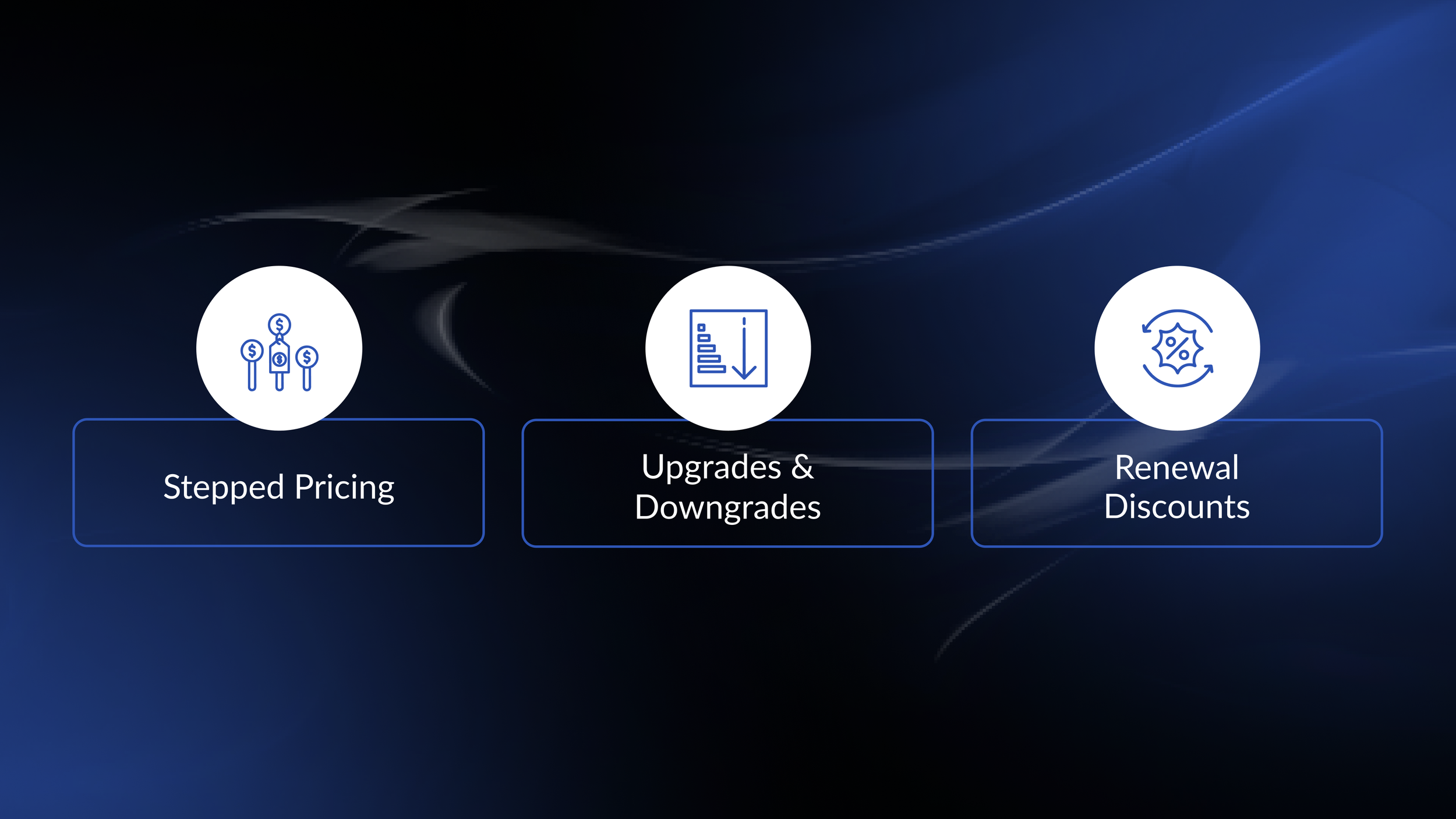
SaaS contracts can change after signing, affecting how and when revenue is recognized. Three areas need particular attention.
Stepped Pricing: When subscription fees increase over the contract term, assess whether the change reflects a different service or the same service at different prices. This determines whether revenue follows the billing schedule or must be recognized over the contract term.
Upgrades & Downgrades: When a customer changes their subscription mid-term, determine whether the change adds distinct services at their standalone selling price or modifies the existing contract. Update the revenue schedule based on the applicable treatment.
Renewal Discounts: If a customer receives a renewal discount linked to an upfront setup fee, assess whether the discount creates a material right. If it does, the setup fee may need to be recognized over a longer period.
What a Reviewer Will Ask
Why did recognized revenue stay the same when the invoice amount increased?
What Evidence Do You Need?
A schedule roll-forward showing the opening balance, new billings, the monthly release, and the closing balance, split between current and long-term.
How Do You Keep Accounting for SaaS Contracts Ready for Review?
Follow these four steps each month to keep contract terms, accounting entries, and supporting records aligned.
Review contract terms: Document the accounting assessment for setup fees, financing, and pricing changes alongside the revenue schedule.
Reconcile usage and billing: Compare usage data with invoices and record unbilled revenue where needed.
Reconcile deferred revenue: Match current and long-term deferred revenue balances to the revenue schedule.
Document changes: Record the reason for any change in accounting treatment and its impact on reported revenue.
As contract volumes grow, managing these schedules in a general ledger-connected system can make reconciliation easier. 1116 Partners’ SaaS Accounting Services support SaaS businesses with these accounting processes.
1116 Perspective | The Schedule Is the Contract in Numbers
A multi-year contract is only as reliable as the schedule built from it. When the term, the price steps, and the payment dates are captured at signing, the books can answer a diligence question in minutes. When they live in an email thread, every renewal becomes a search.
Get Accounting for SaaS Contracts Right With 1116 Partners

Setup fees, usage charges, and multi-year terms each add a judgment that shows up in revenue, deferred revenue, and the metrics investors read. Reliable numbers depend on books that follow ASC 606, track every contract term accurately, and apply the same method each period.
1116 Partners works as an extension of your leadership team, with Controllers and Senior Accountants who build and run the accounting foundation for growing SaaS companies. That includes Fractional Controller Services, Month-End Close Services, and FP&A and Forecasting Services, built for companies that need their reporting to keep pace with their growth.
FAQs
-
Total contract value is the full amount of a contract across its term, ARR is the annualized value of recurring subscription revenue, and recognized revenue is what has been earned under ASC 606.
A three-year, $360,000 prepaid deal has a TCV of $360,000, an ARR of about $120,000, and recognized revenue that builds by $10,000 a month. ARR definitions vary, so document yours, and see our blog on SaaS performance metrics for how ARR feeds retention and efficiency measures.
-
No. A fee is revenue, and a cost is an expense unless it qualifies for capitalization. Costs to fulfill a contract can be capitalized under ASC 340-40 only if they relate directly to the contract, generate or enhance resources used to satisfy future obligations, and are expected to be recovered. Confirm the treatment with your accountant.
-
A discount lowers the transaction price, and a free period inside a committed term is generally spread across the full term rather than recorded as months with no revenue. Contract terms determine the treatment, so review each one before building the schedule.
-
When usage is complete, record the actual amount. When data is still arriving at close, record a documented estimate and true it up the next month. Estimating regularly is a signal that the usage feed needs fixing.
-
Payment timing doesn’t decide it. The same test applies: if the setup work doesn’t deliver a separate service, recognize the fee over the term even if the cash arrives on day one.