

What Is Service Revenue in Accounting? A Guide to Recognition & Journal Entries
The project is finished. A consulting firm has completed $6,000 of work for a client in March and sent the invoice that same month. The only catch is that the client won’t pay until April.
So, when should the firm record the $6,000 as revenue?
This is where service revenue accounting gets a little more interesting. The answer depends on when the business recognizes the revenue and which accounting method it follows. Under accrual accounting, businesses generally recognize revenue when they perform the service. Meanwhile, under cash-basis accounting, it is recognized when payment is received.
This blog explains service revenue in accounting from the ground up; when it should be recognized, how to record it, and how it flows through the financial statements.
Key Takeaways
- Service revenue in accounting is income earned from providing services to customers, not from selling physical goods.
- Under accrual accounting, recognize revenue when you perform the service, not when you receive payment.
- Under cash accounting, revenue is recorded when the customer pays.
- Accounting for service revenue depends on whether the customer pays immediately, is billed after the service, or pays in advance.
- Payments received before a service is delivered are generally recorded as deferred revenue until the service is provided.
What Is Service Revenue in Accounting?
Service revenue in accounting is income a business earns by providing services, expertise, labor, or specialized work to customers. Common examples include consulting, accounting, legal services, IT support, software implementation, professional training, and recurring service arrangements.
Unlike product revenue, which comes from selling goods, service revenue comes from work performed for a customer.
For example, a consulting firm that completes a $6,000 engagement has earned $6,000 of service revenue. Whether the firm records that amount immediately as accounts receivable or as deferred revenue depends on the timing of the service and payment.
Service income accounting is sometimes used interchangeably with service revenue accounting, and both fall under the broader umbrella of service revenue, which records income earned from providing services regardless of the term used.
What Are Examples of Service Revenue?
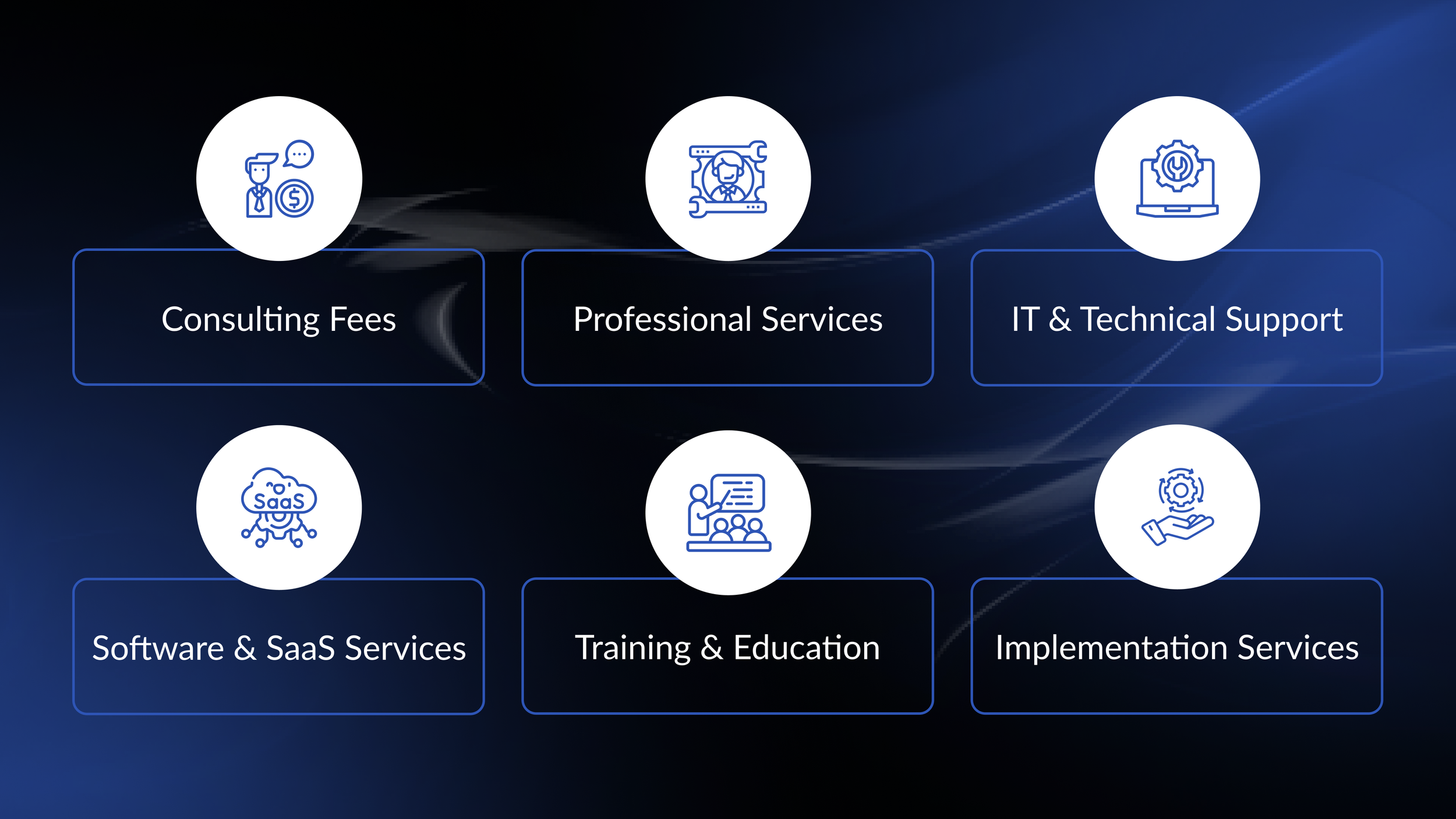
Service revenue is earned when a business provides expertise, labor, access, or ongoing support to a customer. It can take different forms depending on the industry, the type of service, and how the customer is billed. Some common examples of service revenue in accounting include:
Consulting Fees: A consulting firm earns revenue by providing business, financial, marketing, technology, or operational advice. The revenue may be based on hourly work, a fixed project fee, or a longer-term engagement.
Professional Services: Accounting firms, law firms, engineering firms, and other professional practices earn service revenue for work performed for clients. For example, an accounting firm may earn revenue for preparing financial statements or providing tax services.
IT & Technical Support: Technology companies can earn revenue from managed IT services, system maintenance, technical support, or ongoing monitoring. These arrangements may generate recurring service revenue over the contract period.
Software & SaaS Services: A SaaS company may earn revenue by providing customers with ongoing access to its software. If customers pay for access over a set subscription period, the company generally recognizes revenue as it provides the service rather than all at once when it receives payment.
Training & Education: Businesses and educational providers can earn service revenue from workshops, professional courses, certification programs, and customized training. Revenue may depend on when the training is delivered and the terms of the customer agreement.
Implementation Services: A technology provider may charge customers to configure, integrate, or implement software. These fees represent revenue for services performed as part of the customer engagement.
How to Calculate Service Revenue
For a business that sells both products and services, it's often useful to know what share of total revenue comes from services, since that split affects everything from pricing strategy to how growth is driven.
The calculation is simple:
Service Revenue ÷ Total Revenue × 100 = Service Revenue Percentage
Example: A growing business generates $2 million in annual revenue. Of that, $600,000 comes from services (consulting and implementation fees), and the remaining $1.4 million comes from product sales.
$600,000 ÷ $2,000,000 = 0.3
0.3 × 100 = 30%
Service revenue makes up 30% of this business's total revenue. Tracking this over time shows whether the service side is growing faster or slower than the product side, which helps with resourcing, hiring, and where to focus growth efforts.
How Is Service Revenue Recognized?
How a business records service revenue in accounting depends on its accounting method. The key difference is when revenue is recognized: when the service is performed or when the customer pays.
Accrual Accounting
With accrual accounting, businesses generally record service revenue when the service is performed, even if the customer pays later.
For example, a marketing agency completes $8,000 of work in June and sends the invoice in July. Because the agency earned the revenue in June, it records $8,000 of revenue in June.
Cash Accounting
With cash accounting, the agency records service revenue when the customer pays.
Using the same example, if the customer pays the $8,000 invoice in July, the agency records $8,000 of revenue in July.
The simple difference: Accrual accounting follows when the service is earned. Cash accounting follows when the payment is received.
How to Record Service Revenue
Recording service revenue correctly comes down to one thing: matching the journal entry to the timing of service performance relative to payment.
1. Customer Pays Immediately
A business provides a $1,500 service and receives payment immediately.
| Account | Debit | Credit |
|---|---|---|
| Cash | $1,500 | |
| Service Revenue | $1,500 |
2. Service Is Provided on Credit
A business completes $3,200 of work and invoices the customer.
| Account | Debit | Credit |
|---|---|---|
| Accounts Receivable | $3,200 | |
| Service Revenue | $3,200 |
When the customer later pays:
| Account | Debit | Credit |
|---|---|---|
| Cash | $3,200 | |
| Accounts Receivable | $3,200 |
3. Customer Pays in Advance
A customer pays $4,800 before the business provides the service.
At the time of payment:
| Account | Debit | Credit |
|---|---|---|
| Cash | $4,800 | |
| Deferred Revenue | $4,800 |
Once the service is delivered:
| Account | Debit | Credit |
|---|---|---|
| Deferred Revenue | $4,800 | |
| Service Revenue | $4,800 |
The key distinction is simple: cash received does not automatically mean revenue earned.
Is Service Revenue an Asset or a Liability?
Service revenue is a revenue account on an income statement. It is neither an asset nor a liability.
However, earning service revenue can affect the balance sheet:
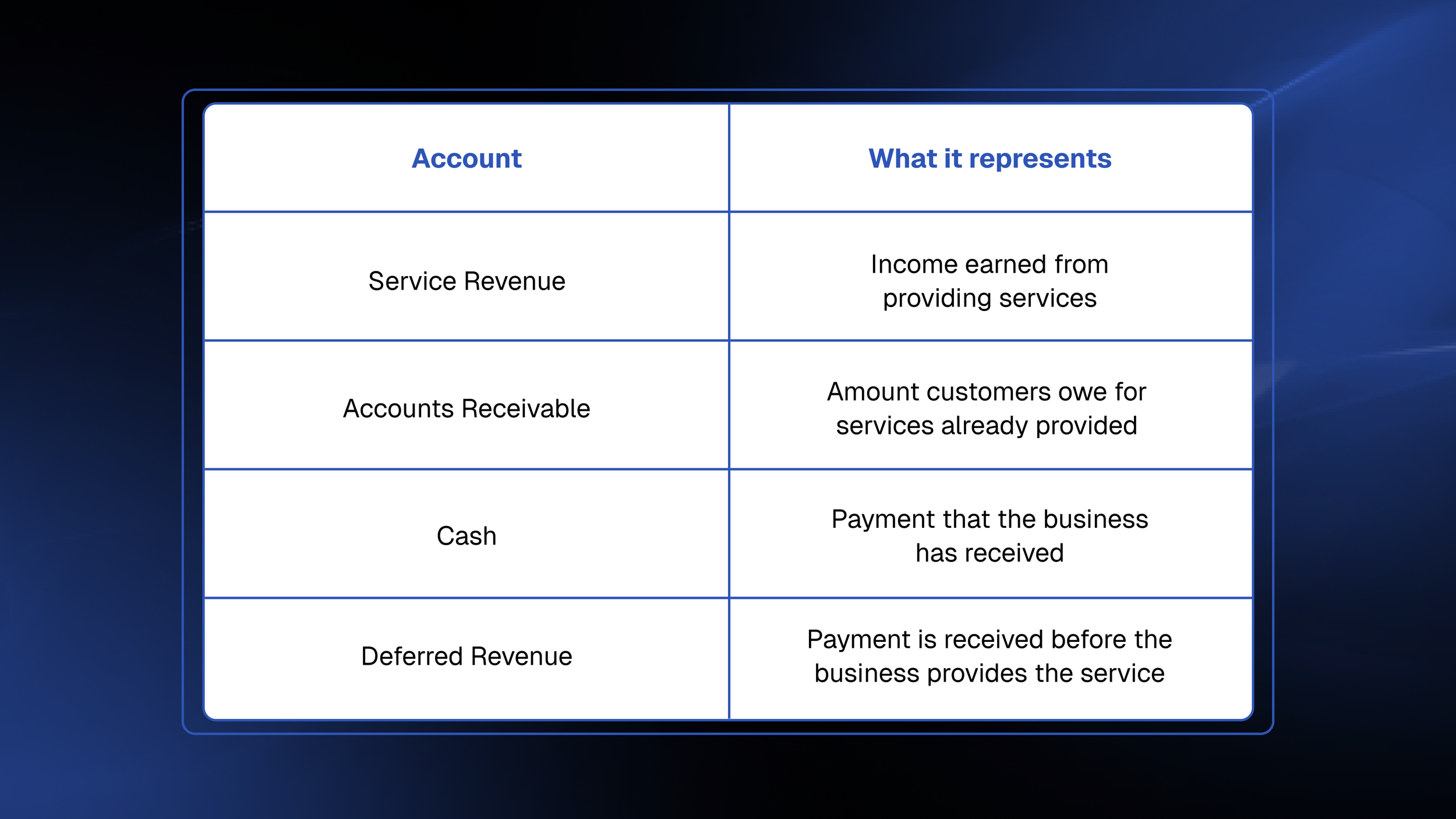
For example, when a business completes $5,000 of work and invoices the customer, it records $5,000 of service revenue and $5,000 of accounts receivable. The revenue appears on the income statement, while receivables appear on the balance sheet.
How Service Revenue Differs From Other Revenue
Service revenue in accounting can be confused with product revenue or deferred revenue, particularly when receivables appear, when sales of products and services occur, or when customers are billed in advance. Understanding the difference helps ensure revenue is recorded in the right period.
Service Revenue vs. Product Revenue
| Feature | Service Revenue | Product Revenue |
|---|---|---|
| What Generates It | Providing a service | Selling a product |
| Examples | Consulting, legal, accounting, SaaS services | Retail goods, inventory, manufactured products |
| Main Accounting Question | When was the service performed? | When did control of the product transfer? |
| Common Timing Issue | Services delivered over time | Delivery or transfer of control |
Service Revenue vs. Deferred Revenue
Service revenue represents income the business has earned. Deferred revenue represents payment received for services the business still owes the customer.
For example, a SaaS company collects $12,000 upfront for 12 months of service. The company initially records the $12,000 as deferred revenue. As the company provides the service, it recognizes the appropriate portion as service revenue.
How Service Revenue Appears on Financial Statements
Service revenue affects all three primary financial statements, but each reflects a different part of the transaction.
Income Statement: Revenue is recognized when earned under accrual accounting. If a consulting firm completes $50,000 of work in March and receives payment in April, the $50,000 appears as March revenue.
Balance Sheet: If the customer hasn’t paid, the $50,000 appears as accounts receivable. If the customer paid before the service was provided, the unearned amount appears as deferred revenue.
Cash Flow Statement: The $50,000 affects operating cash flow when the customer actually pays, which may be a different period from when the revenue was recognized.
The three statements can show different aspects of the same transaction: revenue earned, amounts owed, and cash received.
6 Common Mistakes When Recording Service Revenue
Most service-revenue errors come down to timing rather than calculation.
Recording revenue when cash arrives: An accrual-basis business completes a project in December but records the revenue in January when payment arrives.
Recognizing upfront payments immediately: A customer pays for a 12-month service arrangement, but the business records the entire payment as revenue in the first month.
Missing earned but unbilled revenue: Work is completed before the invoice is issued, but no revenue is recorded for the period in which the work was performed.
Confusing accounts receivable with revenue: Accounts receivable represents money owed by customers, not a separate source of income.
Failing to reconcile revenue with invoices: Canceled engagements, contract changes, or billing adjustments can cause recorded revenue to differ from actual customer activity.
Using inconsistent recognition practices: Similar service arrangements should use a consistent accounting policy.
When Should a Business Review Its Service Revenue Accounting?
Businesses should review their service revenue accounting when changes in contracts, billing, or reporting make the existing process harder to apply consistently.
Adding subscriptions or retainers: Recurring arrangements may create deferred revenue and require recognizing revenue over the service period.
Billing customers in advance: Treat upfront payments as unearned revenue.
Introducing fixed-fee services: Fixed-fee arrangements may require recognizing revenue as the agreed-upon services are performed.
Combining multiple services: Contracts that include onboarding, training, and ongoing support may require separate consideration of how to recognize each service.
Growing transaction volume: As customer and contract volumes increase, manual revenue processes can become harder to manage consistently.
Preparing for external reporting: Investors, lenders, and auditors may require detailed support for revenue balances and the methods used to recognize them.
1116 Perspective: Revenue Timing Matters
Revenue can look straightforward until the timing gets complicated. A business may receive cash today, invoice a customer today, and earn the revenue over several months. Keeping those events separate helps financial statements reflect what the business actually earned during the period.
Keep Service Revenue Reporting on Track With 1116 Partners
Accurate service revenue records are an important part of reliable financial reporting. As businesses add subscriptions, advance billing, or more complex service arrangements, maintaining consistent revenue recognition becomes increasingly important.
1116 Partners supports growing ecommerce and SaaS businesses with financial reporting, bookkeeping, and accounting support to help keep financial records accurate and reporting-ready.
FAQs
-
A consulting firm completes a $5,000 project for a client and earns the fee when it delivers the agreed-upon services. The firm records the $5,000 as service revenue. Other examples include accounting fees, legal services, IT support, software implementation, training, and recurring consulting services.
-
Service revenue accounting covers how a business records and recognizes income earned from providing services. Under accrual accounting, businesses generally recognize revenue when they satisfy their obligation to provide the service, not simply when the customer pays. This helps businesses report revenue in the period it was earned.
For growing businesses, 1116 Partners can help maintain consistent accounting records as service arrangements become more complex.
-
Service revenue normally has a credit balance because revenue increases a company’s equity. When a business earns $5,000 in service revenue and receives payment immediately, the journal entry is:
Debit Cash: $5,000
Credit Service Revenue: $5,000
The credit records the increase in revenue.
-
No. Service revenue is income, not an asset. It appears on the income statement. However, earning service revenue can create an asset on the balance sheet. For example, if a business completes a $5,000 service but has not yet been paid, it records Accounts Receivable as an asset and Service Revenue as income.
-
The entry depends on when payment is received. Immediate payment generally debits Cash and credits Service Revenue. Credit-based billing debits Accounts Receivable and credits Service Revenue. Advance payments are initially recorded as Deferred Revenue.
