

Remote Accounting Services for Growing SaaS Businesses
Your entire team is distributed across four time zones, your product runs on cloud infrastructure, and your customers pay through Stripe without ever stepping into an office. So why should accounting be tied to a local office?
For most growing SaaS companies, it doesn’t have to be. Remote accounting services for SaaS businesses provide bookkeeping, subscription billing reconciliation, and financial reporting through cloud-based tools and virtual communication, fitting naturally with how SaaS companies already operate.
This blog covers what remote accounting includes for a SaaS business, how it addresses subscription billing complexities, and what to look for in a provider.
Key Takeaways
- Remote accounting services deliver the same core accounting work as an in-person bookkeeper, just through cloud software and virtual communication instead of a local office.
- SaaS companies are an ideal match for remote accounting, since most already run on distributed teams and cloud-based billing tools.
- Security depends on the provider’s systems and access controls, not on physical proximity, a real consideration when handling sensitive billing and customer payment data.
- The right remote provider should understand SaaS-specific concepts like deferred revenue, MRR, and ARR, not just general bookkeeping.
What Are Remote Accounting Services for Growing SaaS Businesses
Remote accounting services provide bookkeeping, reconciliations, financial reporting, and related accounting support through cloud-based tools, without requiring an on-site accountant.
For SaaS businesses, this can include managing subscription revenue, recurring billing, and investor-focused financial metrics, all through a remote team.
The work itself remains the same. Transactions still need to be recorded, subscription revenue reconciled, and financial statements prepared. For more on SaaS-specific accounting, including revenue recognition and deferred revenue.
Remote accounting is often part of a broader Outsourced Accounting Services engagement, giving SaaS businesses ongoing accounting support as their subscription activity grows.
1116 Perspective: Expertise Matters More Than Location
SaaS companies are often the businesses least worried about the “remote” part of remote accounting; you’re already running a fully distributed team on cloud tools. The real question isn’t whether remote works. It’s whether the accountant on the other end actually understands subscription revenue, or is learning it on your books.
Why Remote Accounting Works Well for SaaS Businesses
Several characteristics of the SaaS model make remote accounting a practical option:
Cloud-based billing systems: Platforms such as Stripe, Chargebee, and Recurly are designed for online billing and integrations, making it easier for accounting teams to access and reconcile financial data remotely.
Remote-friendly operating models: Many SaaS businesses already operate with distributed teams and cloud-based workflows. A remote accounting provider can work within the same digital environment without requiring an in-office setup.
Access to specialized SaaS expertise: SaaS accounting can involve deferred revenue, ASC 606, recurring billing, and MRR and ARR reporting. Working remotely gives businesses access to accounting professionals with relevant experience beyond their local market.
Cloud-based financial reporting: SaaS businesses often need financial information readily available for management, board meetings, fundraising, and due diligence. A remote accounting team using cloud-based systems can meet that need with accessible, up-to-date records and reporting.
What’s Included in Remote Accounting for SaaS Businesses?
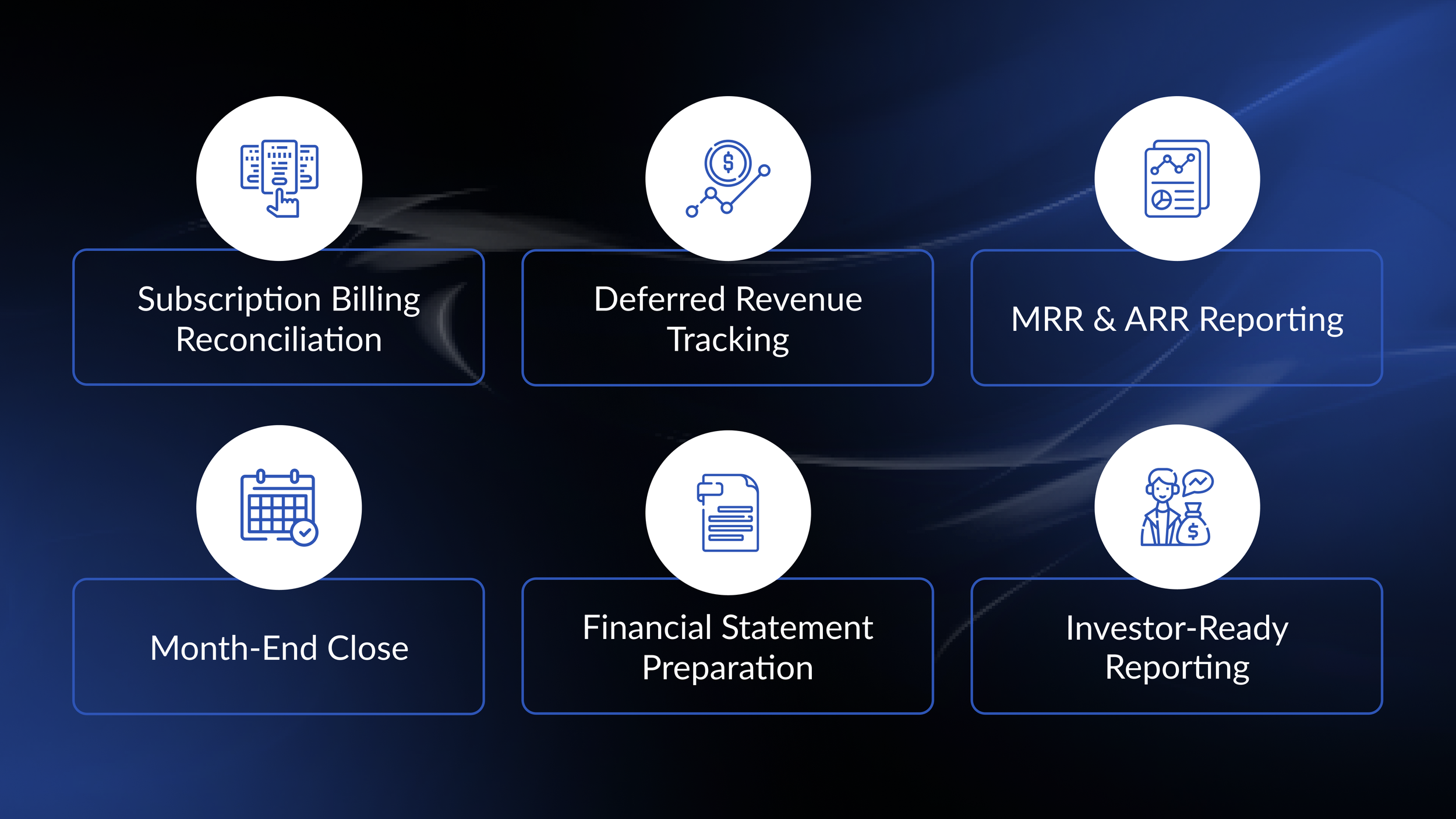
Depending on the engagement, remote accounting for a SaaS business can include:
Subscription Billing Reconciliation: Matching billing data from Stripe, Chargebee, or similar platforms against your accounting records, so recurring charges, upgrades, downgrades, and failed payments are all accurately reflected.
Deferred Revenue Tracking: Recognizing subscription revenue over the service period rather than all at once when cash is collected, a core mechanic of SaaS accounting.
MRR & ARR Reporting: Delivering the recurring-revenue metrics investors and leadership actually track, on a regular cadence.
Month-End Close: Running a consistent close process remotely, with results delivered through a shared dashboard rather than an in-person handoff.
Financial Statement Preparation: Producing GAAP-compliant income statements, balance sheets, and cash flow statements built around subscription revenue.
Investor-Ready Reporting: Preparing financials formatted for the kind of scrutiny a fundraise or board update actually requires.
How Does Remote Accounting Work for a SaaS Business?
Remote accounting works through the same cloud-based systems many SaaS businesses already rely on. The accounting team can access financial data, manage recurring tasks, and communicate with your team without being in the same location.
Billing platform integrations: Platforms such as Stripe, Chargebee, and Recurly can connect with accounting software to capture subscription charges, refunds, and plan changes, reducing manual data entry and reconciliation.
Cloud-based accounting software: Tools such as QuickBooks Online and Xero let the remote accounting team and internal staff work from the same financial records and access up-to-date information.
Secure document sharing: Financial records and billing documents can be exchanged through secure document portals with controlled access, rather than relying on email attachments.
Regular virtual meetings: Scheduled video meetings provide an opportunity to review financial results, address accounting questions, and discuss upcoming needs. Meetings can be more frequent during periods such as fundraising or board reporting.
Day-to-day communication: Messaging platforms allow teams to handle routine questions and accounting updates without waiting for the next scheduled meeting.
Is Remote Accounting Secure for SaaS Companies?
Yes, remote accounting is secure for SaaS companies, as long as the accounting provider has appropriate security measures in place. Key factors include how financial data is stored, who can access it, and how that access is controlled.
When evaluating a provider, look for:
- Encrypted, cloud-based systems: Handle sensitive financial and billing information through secure platforms rather than unsecured email attachments.
- Controlled access permissions: Each team member should have access only to the systems and information required for their role.
- Two-factor authentication: Financial and accounting platforms should use additional authentication to protect against unauthorized access.
- Clear data policies: The provider should explain how it stores, accesses, retains, and handles financial data throughout the engagement.
For a SaaS company, the provider’s security practices should receive the same level of attention as its accounting capabilities. If your business takes customer data security seriously, the accounting partner handling sensitive financial information should meet an appropriate standard of care.
5 Benefits of Remote Accounting for Growing SaaS Businesses
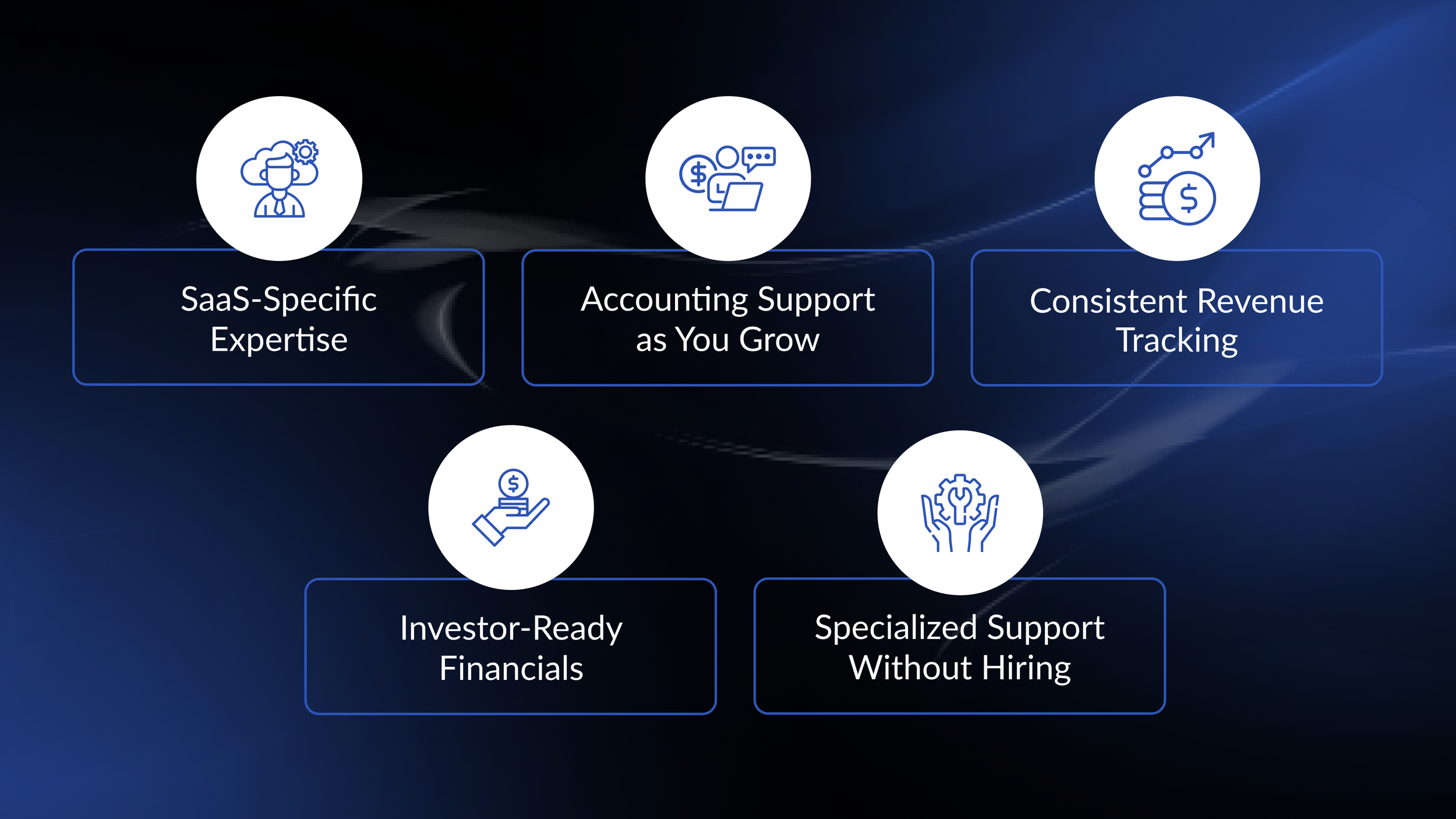
For SaaS companies, accounting needs change as subscription volume, billing activity, and reporting requirements grow. A remote accounting team can provide specialized support without requiring the business to build the entire function in-house.
1. SaaS-Specific Expertise
Work with accountants familiar with recurring revenue models, deferred revenue, ASC 606, subscription changes, refunds, and SaaS metrics such as MRR and ARR. This reduces the need to explain your business model’s accounting implications at every step — and the difference shows up in outcomes: according to TaxDome’s 2025 Niche Business Accounting Report, clients are willing to pay 25% more for a firm that specializes in their niche, and only 2% ever return to a generalist once they’ve worked with a specialist.
2. Accounting Support as You Grow
As customer and transaction volumes increase, the accounting workload grows. A remote team can take on additional bookkeeping, reconciliations, revenue schedules, and reporting without requiring the business to immediately expand its internal accounting team.
3. Consistent Revenue Tracking
SaaS businesses often deal with monthly and annual subscriptions, upgrades, cancellations, credits, and advance payments. Dedicated accounting support helps keep billing activity, deferred revenue, and recognized revenue aligned as these transactions increase.
4. Investor-Ready Financials
Fundraising and board reporting often require clear financial information and consistent SaaS metrics. A provider familiar with SaaS reporting can help maintain the underlying accounting records and reports needed for those conversations.
5. Specialized Support Without Hiring
A growing SaaS company may need expertise in revenue recognition, reconciliations, reporting, and close processes without hiring a separate in-house employee for each skill. A remote team can provide access to that accounting capacity as needed.
Find a Remote Accounting Provider for Your SaaS Business in 5 Easy Steps
The right provider should understand how SaaS businesses bill customers, recognize revenue, and report financial performance. Use these five steps to assess whether a provider is equipped for your business.
Step 1: Check Their Saas Accounting Experience
Ask whether they regularly handle deferred revenue schedules, ASC 606, recurring billing, upgrades, cancellations, and refunds. SaaS accounting has its own complexities, so industry experience matters.
Step 2: Confirm billing platform expertise
Make sure they can work with your billing stack, such as Stripe or Chargebee, and reconcile billing activity with the general ledger.
Step 3: Review Their Security Controls
Ask how they handle encryption, authentication, user permissions, and access to financial data. You should know who can access your systems and how you manage that access.
Step 4: Define Your Reporting Needs
Confirm what you’ll receive and how often. Depending on your business, that may include MRR, ARR, revenue, receivables, and other financial reports. Reporting should also accommodate periods when you need more frequent visibility, such as a fundraise or board meeting.
Step 5: Get The Scope In Writing
Clarify exactly what the engagement covers, including bookkeeping, reconciliations, revenue schedules, financial reporting, and investor support. A clear scope prevents gaps as your accounting needs grow.
How 1116 Partners Supports Growing SaaS Businesses
Here’s how we stack up against the criteria above, specifically:
SaaS expertise from day one: Our team works with growing SaaS companies as a core part of our practice. Deferred revenue schedules, ASC 606 compliance, and recurring revenue mechanics are familiar parts of the work.
Direct integration with your billing platforms: We work with Stripe, Chargebee, and similar platforms so subscription data flows accurately into your books, reducing the need for manual reconciliation.
Defined security & access controls: We use encrypted, cloud-based systems with established access controls to protect financial information and maintain appropriate access levels.
Reporting built around your actual cadence: Regular MRR and ARR reporting provides ongoing visibility, with frequency adjusted around a fundraise, board meeting, or other high-stakes business event.
A scope that grows with you: 1116 Partners brings Controllers and Senior Accountants into the relationship as your needs grow, starting with Outsourced Accounting Services and SaaS Bookkeeping Services, and extending into Month-End Close Services, Fractional Controller Services, and CFO-level advisory as your business matures. You’re not locked into a single tier of support you’ll eventually outgrow.
Get Remote Accounting Built for Your SaaS Business With 1116 Partners

Your team already works remotely. Your billing already runs in the cloud. Your accounting should keep pace with how your business actually operates.
1116 Partners provides remote accounting support as part of our Outsourced Accounting Services and SaaS Bookkeeping Services, built for growing SaaS companies that need a team fluent in subscription revenue, not one learning it on your books.
FAQs
-
It depends on the provider; this is one of the most important things to confirm before signing on. A generalist remote bookkeeper may not have direct experience with subscription revenue mechanics, while a SaaS-focused provider will already be fluent in them.
-
Security depends on the provider’s systems, not physical location. Look for encrypted platforms, defined access controls, and two-factor authentication- the same standards you likely hold your own product to.
-
Yes. Many SaaS companies use remote accounting to supplement internal staff, handling bookkeeping, reconciliations, or reporting while internal team members focus on other priorities.
-
A SaaS-experienced provider recognizes subscription revenue over the service period rather than all at once when cash is collected, tracking deferred revenue as a liability until it’s actually earned, the same core mechanic covered in-What Is SaaS Accounting?
-
Most combine cloud accounting platforms like QuickBooks Online or Xero with billing-specific integrations for Stripe, Chargebee, or Recurly, depending on what the SaaS business already uses.
