Key Takeaways
- Software revenue recognition ties revenue to delivery of the service, so cash received in advance is a liability until it is earned.
- SaaS revenue recognition gets harder with upgrades, downgrades, implementation fees, and usage-based charges because each changes when or how much revenue is recognized.
- No standard prescribes which line item should hold hosting, support, or customer success costs, so each company needs a written policy and must apply it every period.
- Moving a cost between cost of revenue, R&D, and sales and marketing changes gross margin and CAC even when the business hasn’t changed.
- Review revenue recognition and cost classification together at each close, because gross margin depends on both.
A SaaS controller closes the quarter with gross margin up six points. Pricing, churn, and the hosting bill were all flat. The difference was a customer success team that moved out of cost of revenue and into sales and marketing when the department was renamed. Revenue was recognized correctly, but the costs behind it were classified differently than the prior quarter, so the improvement was never real.
Software revenue recognition is the accounting rule that decides when a software company records revenue. For SaaS, that means gradually as the service is delivered, not when cash arrives. Under ASC 606, an annual subscription sits in deferred revenue and releases monthly, and costs to deliver it need consistent classification to keep gross margin reliable.
This blog covers how SaaS revenue recognition works, what makes subscriptions different, and where hosting, R&D, and customer success costs belong.
What Is Software Revenue Recognition?
Software revenue recognition is the process of deciding when and how much revenue a software company records from its customers. For companies that sell subscriptions, ASC 606 ties revenue to transferring a promised service to the customer rather than to billing or payment.
A customer who pays $60,000 for a year of access on October 1 has not given the company $60,000 of revenue that day. The company has received cash and owes twelve months of service. The cash is recorded as deferred revenue, a liability, and it moves into revenue as each month of service is delivered.
1116 Perspective | Cash Is Not Revenue
Founders watch the bank balance, and investors watch recognized revenue. The two diverge most for fast-growing subscription companies with annual prepayments, so a strong cash month can sit beside a modest revenue month and still be entirely normal.
How Does SaaS Revenue Recognition Work?
Under ASC 606, companies follow a five-step model:
Identify the customer contract.
Identify the performance obligations.
Determine the transaction price.
Allocate the price across the performance obligations.
Recognize revenue as each obligation is satisfied.
The FASB set out this model in ASU 2014-09. For a standard subscription, the work is mostly in step five: a single obligation to provide access to the platform is satisfied evenly over the term, so revenue is recognized in equal monthly amounts.
Here is how that looks for the $60,000 annual contract signed on October 1 and paid upfront:
At payment: Debit cash $60,000 and credit deferred revenue $60,000.
Each month: Debit deferred revenue $5,000 and credit subscription revenue $5,000.
By December 31: Three months are earned, so $15,000 sits in revenue and $45,000 remains in deferred revenue.
For a fuller look at the journal entries, see our blog on service revenue in accounting. For how the ledger and tech stack carry these entries each month, see How to Build a Software as a Service Accounting Ledger & Tech Stack.
What Makes Software Revenue Recognition Different for SaaS?
A flat subscription is the simplest case. In practice, SaaS contracts can change mid-term, bundle services, or charge customers based on usage. Each scenario affects when and how revenue is recognized.
Accounting for Upgrades & Downgrades
A mid-term upgrade or downgrade changes a customer’s contract terms. The accounting treatment depends on whether the change adds distinct services at their standalone selling price or modifies the existing contract.
This affects how revenue is recognized over the remaining subscription term. Update the revenue schedule as soon as the contract change is approved.
Recognizing Implementation & Setup Fees
Onboarding and setup fees require a closer look at the service being provided. If the work is distinct and the customer can benefit from it independently, revenue may be recognized as the service is performed. If the work only enables the customer to access the platform, the fee is generally recognized over the subscription term.
The contract terms and nature of the service determine the treatment, so document the assessment for each type of implementation fee.
Recording Usage-Based Revenue
Usage-based charges depend on how much a customer consumes, so you generally recognize revenue as that usage occurs. However, the billing cycle may lag behind consumption.
This creates unbilled revenue, which represents revenue already earned but not yet invoiced. Your accounting process should capture these amounts in the correct period rather than waiting for the invoice to be issued.
1116 Perspective | Contracts Drive the Schedule
Most revenue errors in SaaS companies start with a contract term that never reached finance. A discount, a free period, or a mid-term change agreed in sales needs to land in the revenue schedule, or the books will recognize something the customer never agreed to.
Common Mistakes in Software Revenue Recognition & Cost Classification
Revenue Recognition: Recording revenue when the invoice goes out. Recording annual invoices as revenue on day one inflates the quarter and overstates growth.
Contract Changes: Ignoring upgrades, discounts, and free periods. Changes agreed outside finance leave the revenue schedule out of date.
Cost Classification: Changing the rules midyear. Shifting expenses between categories affects gross margin and makes period-to-period comparisons unreliable.
Customer Success: Placing the entire team in one expense category. Classifying everyone under sales and marketing or cost of revenue can distort CAC or gross margin.
Software Development: Capitalizing costs without a clear policy. Capitalized software needs dedicated accounts, a defined start date, and an amortization method that auditors can follow.
Most of these mistakes stem from early decisions that are never revisited. A clear accounting policy helps prevent them before they create problems during fundraising or an audit. For the wider setup, see our blog: Remote Accounting Services for Growing SaaS Businesses.
Which SaaS Costs Belong Where?
Revenue recognition determines when a SaaS company records revenue. Cost classification determines which expenses match that revenue, directly affecting gross margin.
Accounting standards don’t prescribe a specific line item for every SaaS expense. Companies need a consistent policy based on what each team does, whether a cost supports current service delivery or future development, and how the business operates.
SaaS Cost Classification at a Glance
| Cost | Typical Classification | Why It Matters |
|---|---|---|
| Production Hosting & Infrastructure | Cost of revenue | Runs the product customers use, so it directly reduces gross margin. |
| Customer Support After Sale | Cost of revenue | Keeps the service working for paying customers. |
| Third-Party Software Embedded in the Product | Cost of revenue | A delivery cost that grows with the customer base. |
| Customer Success Onboarding & Adoption | Cost of revenue | Gets customers live and using the service they bought. |
| Customer Success Renewals & Upsells | Sales and marketing | Spent on growing revenue from existing customers, so it belongs with selling costs. |
| Engineering for New Features | Research and development | Builds future capability rather than serving current customers. |
| Development & Testing Environments | Research and development | Supports building and testing, not delivering the service. |
| Sales Commissions | Sales and marketing | May be capitalized and amortized under ASC 340-40. |
These classifications are a starting point, not universal rules. The final treatment depends on the work being performed, the company’s accounting policy, and the applicable accounting guidance.
How to Organize & Classify SaaS Costs
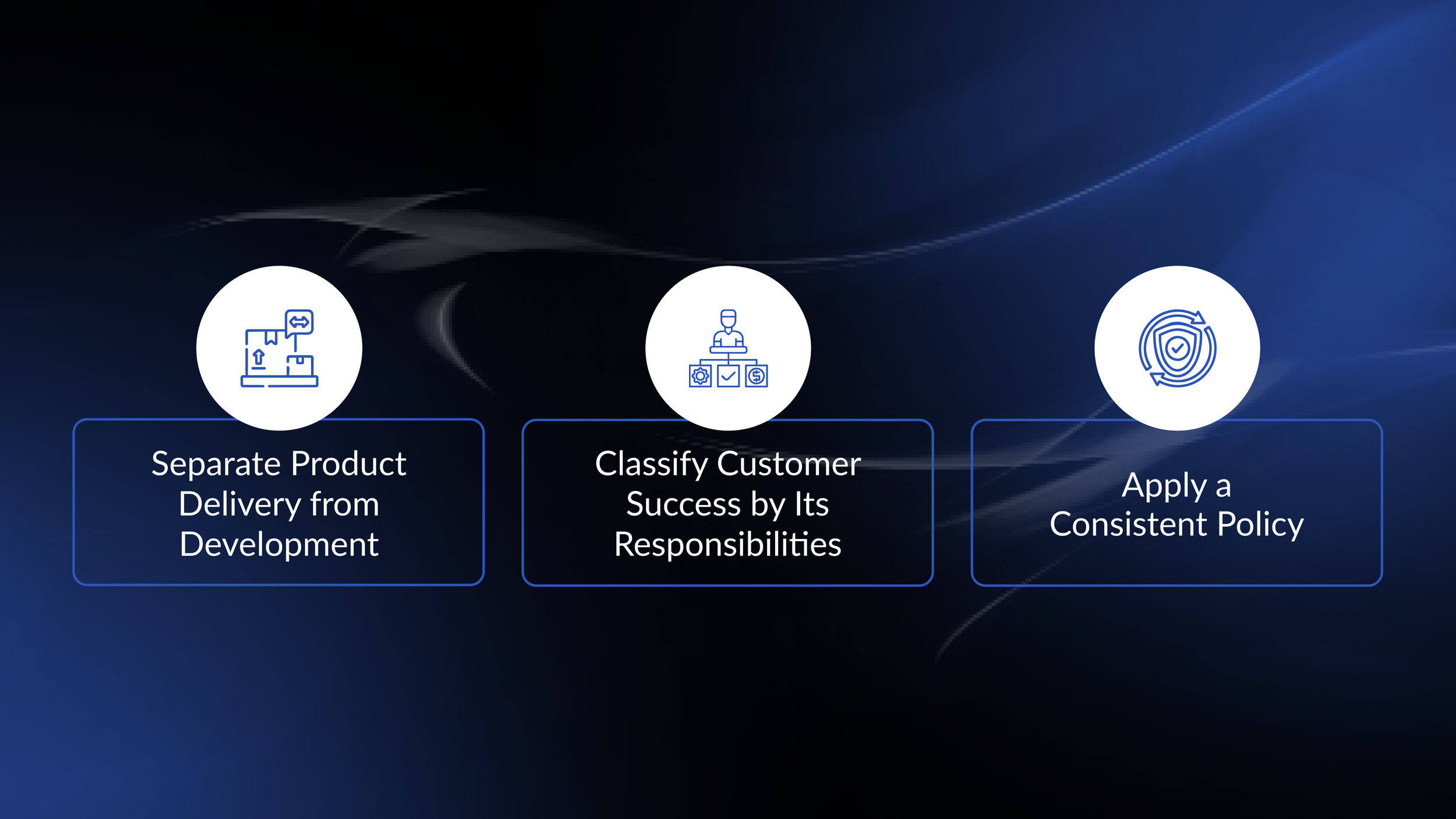
Consistent cost classification helps SaaS businesses accurately track gross margin, operating expenses, and customer acquisition cost (CAC).
1. Separate Product Delivery from Development
Cloud bills may cover both live product infrastructure and development environments. Classify costs based on their use:
Production hosting: Cost of revenue.
Development and testing: Research and development (R&D).
Shared infrastructure: Allocate costs using cloud tags or another documented, consistent method.
Engineering costs are generally expensed as incurred, though certain software development costs may qualify for capitalization under Subtopic 350-40.
In September 2025, the FASB issued ASU 2025-06, which replaces the project-stage approach with criteria based on management’s funding commitment and the probability of completion. It applies to annual periods beginning after December 15, 2027, and may reduce capitalization for software provided through the cloud.
If you capitalize eligible costs, track them separately and document your policy. For technical questions on capitalization, see our blog on financial accounting advisory services.
2. Classify Customer Success by Its Responsibilities
Customer success teams may support both service delivery and revenue growth. Classify expenses based on the work performed:
Onboarding and adoption: Typically cost of revenue.
Renewals and upsells: Typically sales and marketing.
Shared responsibilities: Allocate costs using a measurable basis, such as time spent or documented account responsibilities.
Apply the same method each period to keep gross margin and CAC calculations reliable.
3. Apply a Consistent Policy
Document how expenses are classified across cost of revenue, R&D, and sales and marketing. Review the policy regularly and explain any changes to maintain comparable financial results over time.
1116 Perspective | Consistency Makes Classifications Defensible
A reasonable classification is easier to defend when the company can explain how it reached the decision and show that the same rule was applied each period. Document the policy, record changes, and assess their effect on financial reporting before adjusting.
How Do Revenue Recognition & Cost Classification Move Gross Margin?
Gross margin is recognized revenue minus cost of revenue, so a mistake in software revenue recognition or in cost classification changes it. Take a quarter with $500,000 of recognized revenue and these delivery costs:
| Cost | Amount |
|---|---|
| Production hosting | $60,000 |
| Customer support | $40,000 |
| Embedded third-party software | $20,000 |
| Customer success team | $50,000 |
Classifying customer success entirely outside cost of revenue gives $120,000 of cost of revenue and a 76% gross margin. Including the 60% of the team’s time spent on onboarding and adoption raises cost of revenue to $150,000 and cuts gross margin to 70%. The business is the same in both cases. Only the classification changed, a six-point swing from the opening example.
An annual contract billed in full creates billings on day one and revenue recognized over the term, raising CAC and lengthening payback. For how these figures reach investors, see our blog on SaaS performance metrics.
Get Reliable Software Revenue Recognition With 1116 Partners

Revenue recognition and cost classification decide whether your gross margin, CAC, and growth figures hold up when a board, lender, or acquirer examines them. Both depend on books that follow ASC 606, accurately track deferred revenue, and classify costs consistently each period.
1116 Partners extends your leadership team with Controllers and Senior Accountants who build and run the accounting foundation for growing SaaS companies. That includes SaaS Accounting Services, Month-End Close Services, and Fractional Controller Services, built for companies that need their reporting to keep pace with their growth.
FAQs
-
Billings are what you invoice customers, and recognized revenue is what you have earned by delivering the service. An annual contract billed in full creates billings on day one and recognizes revenue over the term.
-
Incremental costs of obtaining a contract, such as commissions, are recognized as an asset if the company expects to recover them, under ASC 340-40. A practical expedient allows expensing when the amortization period would be one year or less. Capitalized amounts are amortized on a basis consistent with how the service transfers to the customer.
-
Some costs can be capitalized under Subtopic 350-40 once the capitalization threshold is met, and ASU 2025-06 changes when that threshold is reached for annual periods beginning after December 15, 2027. The facts of each project decide, so confirm treatment with your accountant before setting up the accounts.
-
It depends on the contract. If the customer is entitled to a refund, the company records a refund liability for the refundable portion. If the prepayment is non-refundable, the remaining deferred revenue is generally recognized once the company has no further obligation to the customer. Review each cancellation against its terms.
-
At least annually, and whenever the product, team structure, or hosting setup changes materially. Record any changes and their effects on prior periods so comparisons stay reliable.