

How to Outsource Accounts Payable Services: A Step-by-Step Guide
Key Takeaways
- Assess your current AP process before deciding what to outsource.
- Define which responsibilities move to the provider and which stay internal.
- Organize vendor records, W-9s, and payment information before the transition, not after.
- Choose a provider that works with your existing accounting and payment systems.
- Establish approval, payment, and segregation-of-duties controls before go-live.
- Run a phased transition and test exceptions, not just standard invoices.
You’ve decided that your finance team shouldn’t be spending hours every week processing invoices. So, you start looking into accounts payable outsourcing services.
Then the questions start piling up.
Who will receive and code invoices?
Who will route them for approval?
Who has authority to release payments?
What happens to your vendor records and W-9s?
How will the provider work with your accounting system?
And when month-end comes around, will the accounts payable (AP) records be ready for the general ledger and reconciliations?
These details can make the difference between a smooth transition and a process that creates more work for your finance team. Outsourcing accounts payable services involves more than moving invoice processing outside the company. Your payment controls, vendor information, accounting workflows, and internal responsibilities all need to move into a clearly defined process.
That’s why the transition should start with a close look at how your AP works today. Once you understand the current workflow, you can decide what to outsource, what your team should keep, and what your provider should take over.
This blog walks you through outsourcing accounts payable services, with practical steps for choosing a provider, preparing your records, setting controls, transitioning the workload, testing the process, and measuring performance once everything is up and running.
What Does It Mean to Outsource Accounts Payable Services?
When a company outsources accounts payable services, it moves some or all routine AP responsibilities to an external provider. Depending on the arrangement, outsourced accounts payable services can include:
Receiving and organizing invoices
Invoice data entry
General ledger coding
Purchase order matching
Approval routing
Vendor communication
Payment preparation
AP reporting
Reconciliation support
Your internal finance team can continue to handle final approvals, payment authorization, cash management, budgeting, accounting policies, and financial oversight. The exact split depends on your business, systems, internal controls, and the scope of the engagement.
Once you know what AP outsourcing entails, the next step is to decide how to structure the transition. The following section can help you move the work over while keeping your accounting and payment processes organized.
Step-by-Step Framework to Outsource Accounts Payable Services
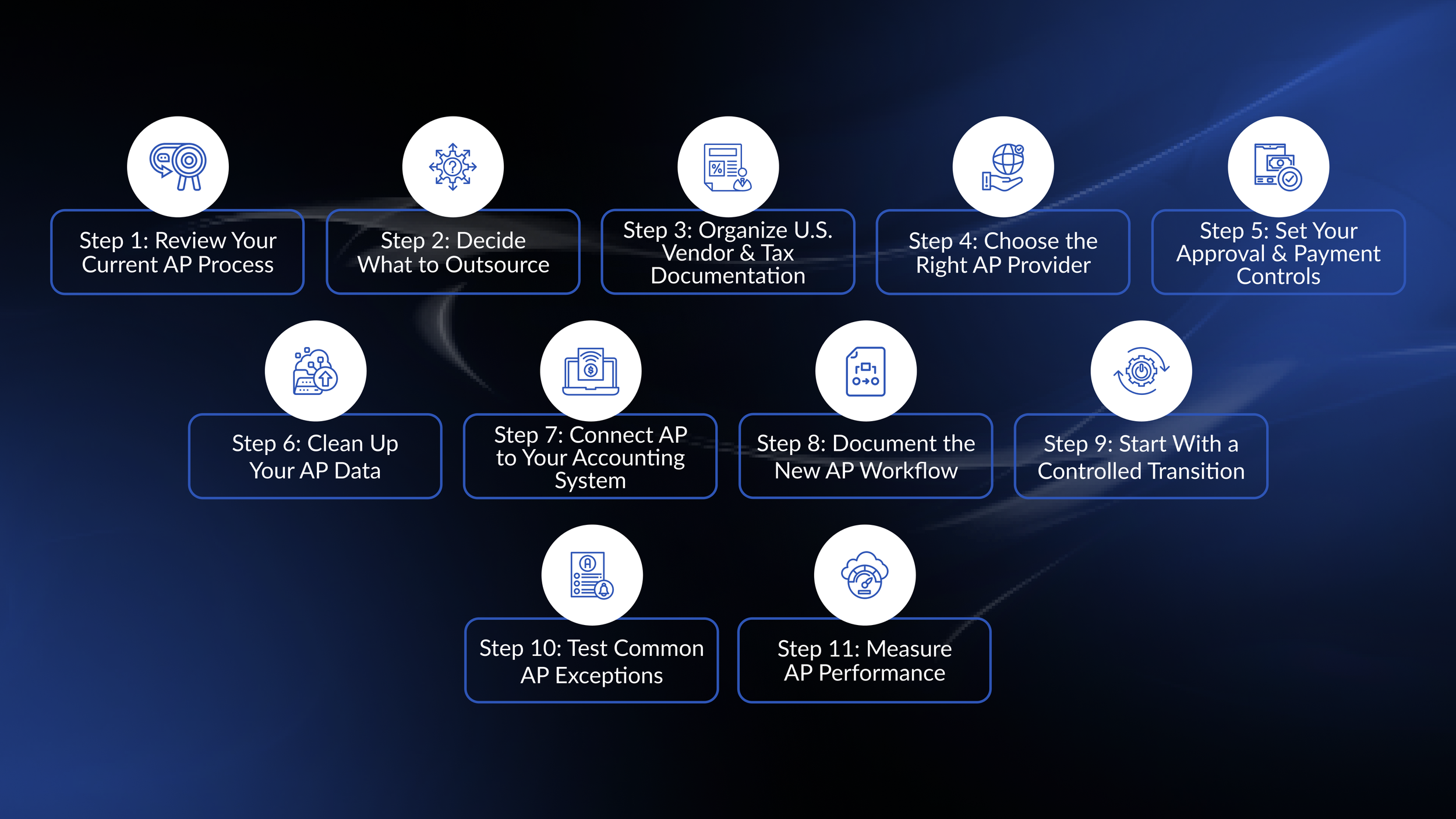
Outsourcing AP works best when you plan the transition before the first invoice moves to an external provider. Follow these steps to move AP to a provider while keeping your accounting and payment controls intact.
Step 1: Review Your Current AP Process
Before you outsource accounts payable services, document your current workflow.
Review:
Monthly invoice volume
Number of active vendors
Payment terms and methods
Approval workflows
Accounting and AP systems
AP aging and reporting
Reconciliation procedures
Month-end close requirements
Use this baseline to identify gaps in the current process and determine what the provider will need to take over.
Step 2: Decide What to Outsource
Determine which AP responsibilities your provider will handle and which will remain with your internal finance team.
Typically outsourced:
Invoice processing
Invoice coding
PO matching
Approval routing
Vendor communication
Payment preparation
AP reporting
Typically kept in-house:
Final invoice approval
Payment authorization
Cash management
Budget decisions
Financial oversight
Straightforward ownership prevents confusion once the provider takes over.
Step 3: Organize U.S. Vendor & Tax Documentation
Before transitioning to AP, organize the documentation your provider and accounting team will need.
This may include:
W-9 forms
Vendor records
Payment information
Invoices and receipts
Supporting payment documentation
Information needed for applicable 1099 reporting
Your AP service should have a streamlined process for storing and retrieving this information, while your tax professional can determine your specific reporting requirements.
Step 4: Choose the Right AP Provider
Once you understand your current process, you can evaluate providers based on the systems, controls, and workflows your business actually needs. At 1116 Partners, we also look closely at how the transition will work in practice, especially when invoices require exceptions or vendor payment details change.
When evaluating a provider, ask two questions directly:
How do you handle an invoice exception on day one, before your team knows our process?
What’s your verification step when a vendor’s bank details change?
These questions can tell you a lot about how a provider approaches the handoff, especially when something doesn’t go according to plan. That practical approach matters to us because a successful AP transition requires more than the standard invoice workflow.
Step 5: Set Your Approval & Payment Controls
Before handing off AP, establish precise rules for who can process, approve, prepare, and authorize payments.
Define:
Approval thresholds
Authorized approvers
Payment authority
User permissions
Segregation of duties
Vendor onboarding procedures
Bank detail change procedures
Duplicate invoice checks
A typical workflow could be:
Invoice received → Reviewed → Coded → Approved → Payment prepared → Payment authorized → Reconciled
Step 6: Clean Up Your AP Data
Prepare the records your provider will need before the transition.
Organize:
Vendor master files
W-9 records
Open invoices
Historical AP records
Chart of accounts
Purchase orders
Payment terms
Approval rules
Payment instructions
Use this step to identify duplicate vendors, outdated payment information, missing documentation, and old outstanding invoices.
Step 7: Connect AP to Your Accounting System
Make sure the provider’s work connects with the rest of your accounting system. Your provider should understand how AP affects:
General ledger
AP balances
Reconciliations
Accruals
Month-end close
Financial reporting
This keeps invoice processing connected to your books and reduces additional reconciliation work for your internal accounting team.
Step 8: Document the New AP Workflow
Create a workflow that both your internal team and provider can follow:
Invoice received → Data captured → Coding → PO matching → Approval → Payment scheduling → Payment → Reconciliation
Document who owns each step, expected turnaround times, escalation procedures, exception handling, and month-end requirements.
Step 9: Start With a Controlled Transition
Avoid moving the entire AP workload at once when a phased transition makes sense.
A simple approach:
Test invoices → Add selected vendors → Increase volume → Complete transition
Monitor processing accuracy, approval times, payment timing, exceptions, vendor issues, and reconciliation results at each stage.
Step 10: Test Common AP Exceptions
Before going fully live, test situations that can disrupt the normal workflow:
Invoice without a PO
Duplicate invoice
Incorrect invoice amount
Missing approval
Urgent payment
Vendor bank detail change
Credit memo
New vendor
Missing W-9
Month-end invoice
Testing these situations early helps identify gaps before they affect your full AP workload.
Step 11: Measure AP Performance
Once the transition is underway, track a few key metrics:
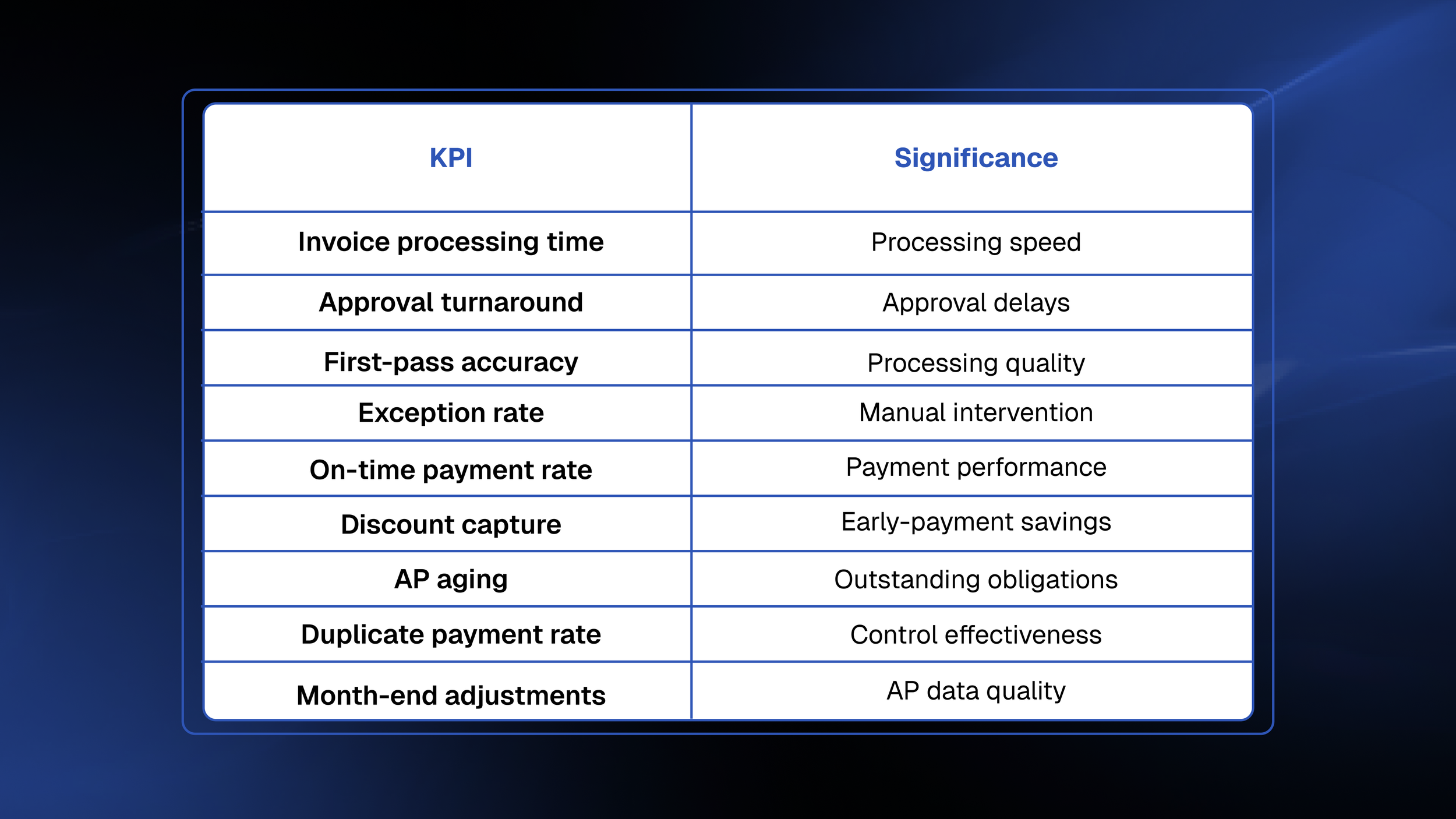
Review the above metrics regularly with your provider and internal finance team. They help you see whether your accounts payable service is improving the process, meeting expectations, and supporting the rest of your accounting workflow.
Once you have the right measures in place, the next consideration is how long the transition will take and what needs to happen before the new process goes live.
Common Mistakes to Avoid When Outsourcing AP
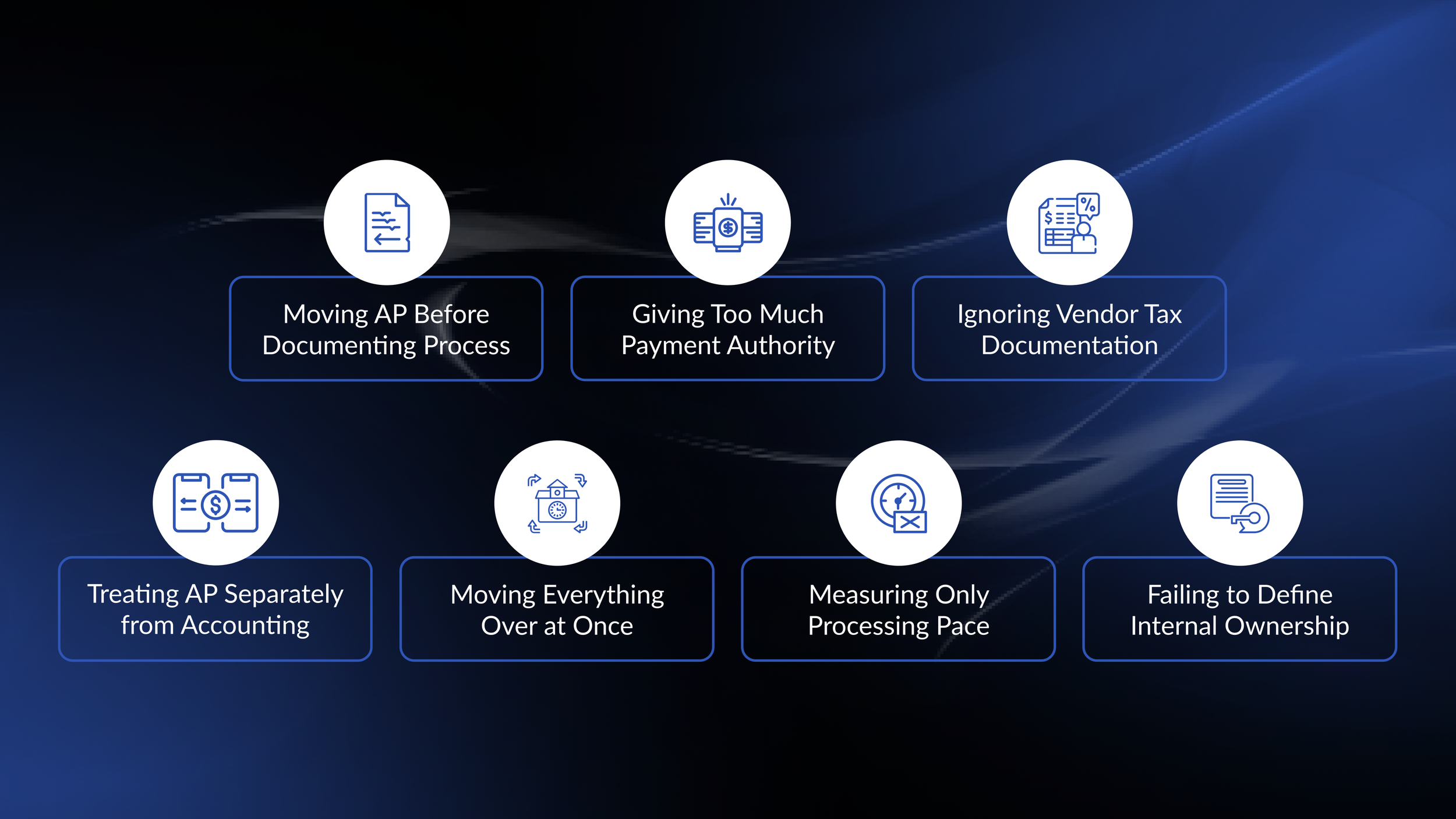
Outsourcing AP can simplify day-to-day processing, but the transition still needs structure. These common mistakes can create delays, control issues, or extra work for your internal finance team.
1. Moving AP Before Documenting Process
Undocumented processes are hard to hand off cleanly. If approval rules, invoice coding, exception handling, and payment procedures only exist as informal knowledge, the provider may struggle to follow them consistently.
2. Giving Too Much Payment Authority
Invoice processing and payment authorization should have clearly defined responsibilities. Giving an external provider broad payment access without appropriate approval controls can create unnecessary financial risk. Before the transition, establish who can prepare, approve, and release payments.
3. Ignoring Vendor Tax Documentation
Missing W-9s, incomplete vendor records, or outdated payment information can create problems during year-end reporting. Your accounts payable service should have a defined process for collecting, storing, and updating applicable vendor documentation throughout the year.
4. Treating AP Separately from Accounting
AP feeds directly into the general ledger, reconciliations, accruals, and month-end close. If your outsourced accounts payable services operate separately from the accounting process, your internal team may spend extra time reconciling information and correcting records.
5. Moving Everything Over at Once
A full transition on day one can make it difficult to identify where problems are coming from. A phased approach lets you test the workflow with a smaller group of invoices or vendors, address issues, and gradually move more AP volume to the provider.
6. Measuring Only Processing Pace
Faster invoice processing doesn’t tell you the whole story. When evaluating accounts payable outsourcing services, also consider accuracy, exception rates, approval turnaround time, on-time payments, reporting quality, and reconciliation results. Measure processing speed alongside accuracy, controls, reporting, and reconciliation quality.
7. Failing to Define Internal Ownership
Your provider and internal finance team should clearly own each stage of the AP process. Define who handles invoice processing, approvals, vendor questions, payment authorization, exceptions, and reconciliation. Transparent ownership prevents invoices from getting stuck between teams and makes accountability much easier.
How Do You Know Your AP Outsourcing Setup Is Working?
Once the new process is established, your finance team should be able to answer key AP questions quickly, without pulling information from multiple spreadsheets or systems.
For example:
What invoices are outstanding?
What payments are due?
Which invoices are waiting for approval?
Are vendors being paid on time?
Are early-payment discounts being captured?
Are AP records ready for month-end close?
Who owns unresolved invoices?
Are exceptions being resolved quickly?
Are payment controls being followed?
Your AP process should also support accurate bookkeeping and financial reporting, with organized records that your accounting and tax teams can rely on.
1116 Partners helps keep these pieces connected, from invoice processing and payment workflows to AP reporting and accounting records. That gives your finance team better visibility into what is owed, what needs attention, and how AP is affecting the broader books.
Once you know what a well-run AP process should look like, the next question is who can help you build and manage it.
Build Reliable Accounts Payable Management With 1116 Partners
Once you decide to outsource accounts payable services, the goal is to make AP easier to manage while keeping your financial oversight and accounting processes intact.
1116 Partners’ accounts payable support is built into our broader Outsourced Bookkeeping Services, so approvals, reporting, and financial controls stay connected to Month-End Close Services and the rest of your accounting function, rather than being treated as a separate task.
Moreover, we handle routine AP work, including invoice processing, vendor communication, AP reporting, and reconciliation support, freeing your internal team to focus on higher-value financial decisions.
FAQs
-
Start by reviewing your current AP process, defining what should move externally, selecting a provider, preparing vendor and accounting data, establishing controls, and transitioning the work through a controlled rollout.
-
Moving the entire workload over at once, before the process has been tested on a smaller scale. A phased rollout- a handful of vendors first, then expanding volume- catches gaps in approval routing, exception handling, and data accuracy while the stakes are still low.
-
Track it against the baseline from your process review: processing time, approval turnaround, exception rate, and on-time payment rate. If those numbers are measurably better 60–90 days in, the transition worked. If they’re not, that signals a need to revisit scope or controls, not necessarily the decision to outsource at all. This is exactly how 1116 Partners approaches every transition: a defined 60–90-day review built into the engagement from day one, not something you have to ask for.
-
The AP process should define how applicable W-9s are collected, stored, updated, and made available for tax reporting. The IRS states that Form W-9 can be used to request a payee’s correct name and taxpayer identification number, and its current guidance recommends retaining W-9s for four years.
-
Keep approval authority, payment authorization, user permissions, and financial oversight assigned. Segregating invoice processing, approval, payment authorization, and reconciliation where practical can also strengthen controls.
